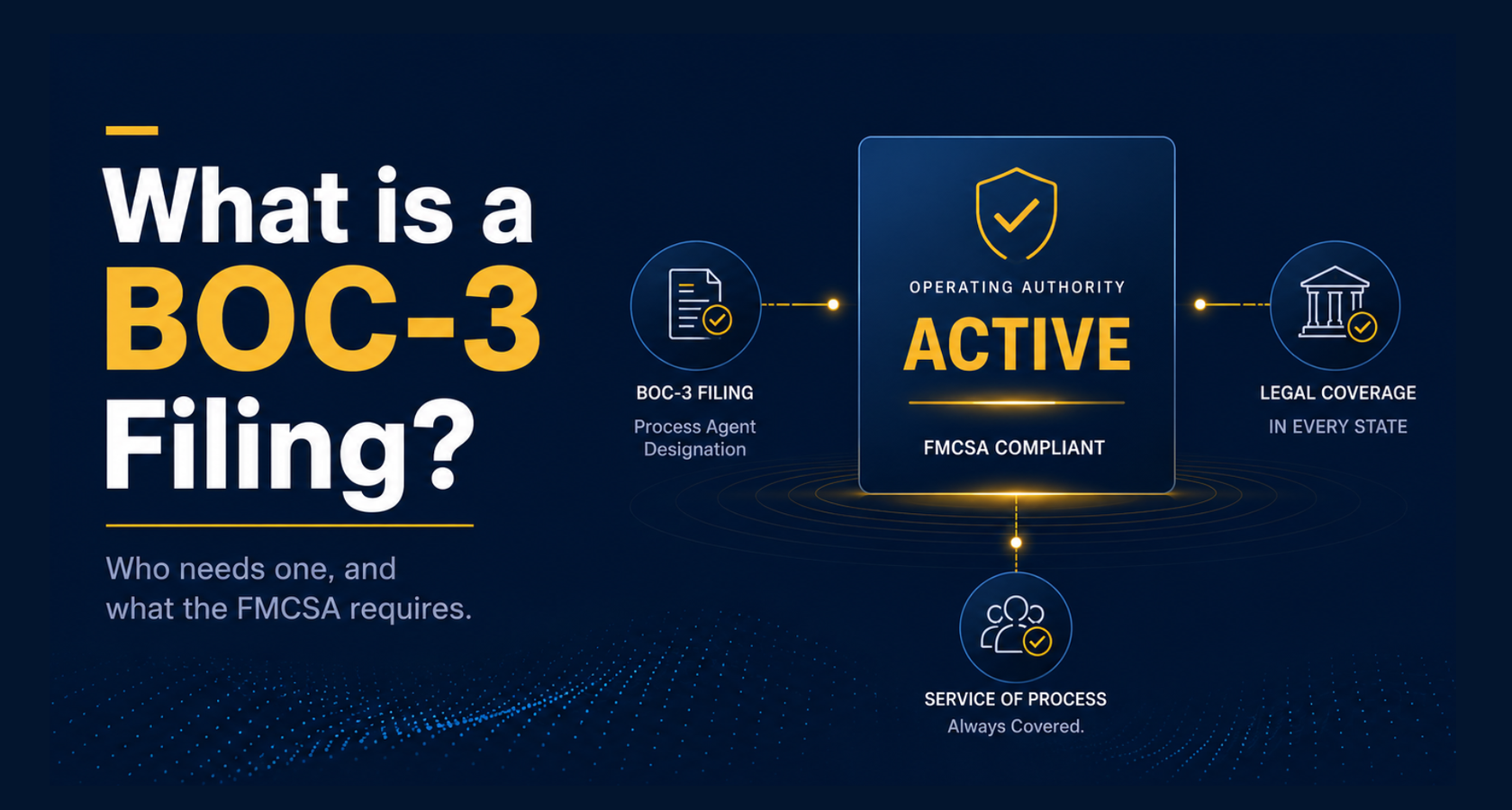
A BOC-3 filing is a required form submitted to the Federal Motor Carrier Safety Administration, known as the FMCSA, that designates a process agent for a motor carrier, freight broker, or freight forwarder. The process agent is the person or company authorized to receive legal papers on the business's behalf in every state where it operates. Without a valid BOC-3 filing on file, the FMCSA will not activate a company's operating authority.
BOC-3 stands for "Blanket of Coverage." Most companies use a single process agent who covers all 50 states at once through what the FMCSA calls a blanket designation, rather than tracking down a separate agent in every state individually.
What a BOC-3 Filing Actually Does
When a company registers for interstate operating authority, the FMCSA needs a dependable way to reach that company if it's ever named in a legal proceeding. Since drivers, equipment, and even office staff can be constantly on the move, the FMCSA requires a fixed point of contact in every state where the business operates. That point of contact is the process agent.
The process agent accepts court papers, subpoenas, and other legal documents on the company's behalf and forwards them along. This is a separate function from the business address filed with the FMCSA. It's a dedicated legal contact built specifically for service of process, so nothing gets missed simply because a truck is three states away from headquarters.
TruckScribe tracks this same authority status on every carrier the moment it changes, since a BOC-3 designation is one of the details that determines whether a carrier's operating authority is active at all.
The Regulation Behind the Requirement
The BOC-3 filing exists under federal regulation 49 CFR Part 366, titled "Designation of Process Agent." This regulation lays out exactly who must file, what the form must include, and what happens if a company fails to file. Under 49 CFR 366.2, only one completed, current BOC-3 form may be on file at a time, and it must list every state where an agent designation is required.
A copy must also be kept on record at the company's principal place of business. The regulation is specific enough that it even sets a hard deadline for failure to comply. According to 49 CFR 366.2, a company that does not file its designation as required will have its USDOT number deactivated.
Who Needs to File a BOC-3
The BOC-3 requirement applies to three categories of businesses operating in interstate commerce under FMCSA authority.
Motor Carriers
Both for-hire and private carriers hauling regulated commodities across state lines generally fall under this requirement. A motor carrier must designate a process agent in every state where it holds operating authority, plus every state its trucks travel through during those operations.
That means a Texas-based carrier authorized to run in 30 states needs coverage in all 30, along with any additional states its routes pass through.
Freight Brokers
A broker arranging the transportation of property in interstate commerce must maintain a BOC-3 designation covering every state where it maintains an office or writes contracts, including the District of Columbia.
This is one of several compliance steps a broker's own carrier network has to clear, which is part of why Freight Brokers rely on verified, current authority data when deciding who to work with.
Freight Forwarders
Freight forwarders follow the same coverage rule as brokers: a process agent designation is required in every state where the business maintains an office or writes contracts.
An Important Exception for Brokers and Forwarders
Unlike motor carriers, which are required to use a designated third-party process agent, a broker or freight forwarder that won't regularly be on the road may, in limited cases, act as its own process agent within its own state of residence. Most brokers and forwarders still choose to work with a professional process agent, since managing multi-state coverage independently gets complicated fast.
Who Is Exempt From Filing a BOC-3
Not every transportation business needs a BOC-3 on file. The most common exemptions include:
- Intrastate-only carriers. A company that operates strictly within a single state and never crosses state lines generally does not need a BOC-3 filing.
- Private carriers. Businesses that haul only their own goods, rather than operating for hire, are typically not required to file. The exception is private carriers conducting international transportation through the United States between two points in a foreign country, who must still file designations for every state they pass through.
- Government-owned carriers. Transportation entities owned and operated by government bodies generally fall outside standard FMCSA authority requirements.
If a business operates in interstate commerce in any capacity, it's worth confirming directly whether an exemption genuinely applies, since the specifics of an operation can change the answer.
Can a Carrier File Its Own BOC-3?
No, not in most cases. A motor carrier cannot file its own BOC-3. Only a registered process agent can submit the filing on a carrier's behalf.
This requirement exists specifically so that every carrier has a truly independent, verifiable legal contact, rather than a company simply certifying its own reachability.
This restriction is also why an entire industry of BOC-3 filing and process agent services exists. Since carriers are required to use a qualified third party, that third party becomes a necessary step in the authority setup process for nearly every new trucking company.
It's exactly the moment BOC-3 Agents step in to serve a carrier that just filed for authority.
The Blanket Process Agent Arrangement
Instead of contracting with a separate agent in each required state, a carrier can use what the FMCSA recognizes as a blanket process agent under 49 CFR 366.5T. A blanket agent maintains a network of designated representatives across every U.S. jurisdiction, so a single filing satisfies the coverage requirement nationwide instead of state by state.
Does a BOC-3 Filing Expire or Need to Be Renewed?
A BOC-3 filing does not expire on its own, and it does not require annual renewal at the regulatory level. Once it's on file and a company's operating authority stays active, the designation generally remains valid indefinitely.
That said, treating a BOC-3 as permanently finished is a common mistake. A new filing is required whenever certain details change, including:
- The company's legal name changes
- Operating authority is transferred to a new entity
- Previously revoked operating authority is reinstated
- The business address or ownership structure changes
- The designated process agent changes or is added
A lapsed or mismatched BOC-3 doesn't just delay a new application. It can affect an operating authority that's already active, since service of process depends on FMCSA's records actually matching the business as it exists today.
Some process agent companies charge an ongoing fee to maintain a filing, but that fee is a commercial arrangement, not a federal renewal requirement.
What Information Is Needed to File a BOC-3
Even though a process agent handles the actual submission, a carrier, broker, or freight forwarder typically needs to provide:
- Business information. The legal name and mailing address of the company.
- Authorized signer. The full name and title of the person authorized to sign on the company's behalf.
- Process agent information. The name and address of the designated process agent or agents in each required state.
A company also needs an active USDOT number, and in most cases an MC number, before a BOC-3 filing can be completed.
How a BOC-3 Filing Differs From Other FMCSA Requirements
A new carrier often completes several FMCSA filings around the same time, and it's easy to confuse the BOC-3 with the others. In short, the BOC-3 is a one-time process agent designation.
It's separate from the Unified Carrier Registration, a different annual filing, and separate from the MCS-150 biennial update, which keeps a carrier's operational details current with the FMCSA. It's also distinct from the BMC-91 insurance filing, which proves financial responsibility rather than designating a legal contact.
This is also around the same window that New Carrier Leads surfaces a carrier for the first time, since most of these filings happen in the days right after a company registers for authority.
Frequently Asked Questions
Is a BOC-3 the same as an MC number?
No. An MC number is the operating authority itself. A BOC-3 is a separate filing required before that authority can be activated. A carrier generally cannot receive an active MC number without a valid BOC-3 on file.
How long does it take to file a BOC-3?
Many process agents can complete a BOC-3 filing within one business day, and some file the same day a request comes in. Processing time on the FMCSA's end can add to that.
Do I need a BOC-3 for intrastate-only operating authority?
Generally, no. The BOC-3 requirement applies to interstate operating authority. A carrier operating only within a single state typically does not need one.
What happens if a BOC-3 filing is late or missing?
Without a valid BOC-3 on file, the FMCSA will not activate operating authority, and an existing USDOT number can be deactivated for failure to maintain a current designation. A pending application can also be delayed or dismissed until the filing is completed.
Can I use a different process agent in each state instead of a blanket agent?
Yes. A carrier can designate a separate process agent for each required state. Most companies choose a single blanket process agent instead, since it satisfies the coverage requirement in every state through one filing rather than several.
Does a BOC-3 filing cost the same for every carrier?
No. Pricing varies by process agent and often depends on whether a carrier chooses single-state coverage or a nationwide blanket designation.
Our methodology page explains how TruckScribe verifies and keeps carrier authority records current across every filing type, BOC-3 included.