A fleet maintenance program is a structured system for inspecting, servicing, and repairing every vehicle in a carrier's operation, built to catch problems before they cause a breakdown or a roadside violation. Rather than fixing things only after they fail, the program schedules regular checks and services at set intervals, so small issues get caught while they are still cheap to fix.
For a trucking company, this is not optional. Federal regulation requires every motor carrier to maintain its vehicles in safe operating condition, and a fleet maintenance program is how a carrier actually meets that requirement in practice, day after day.
What Is a Fleet Maintenance Program?
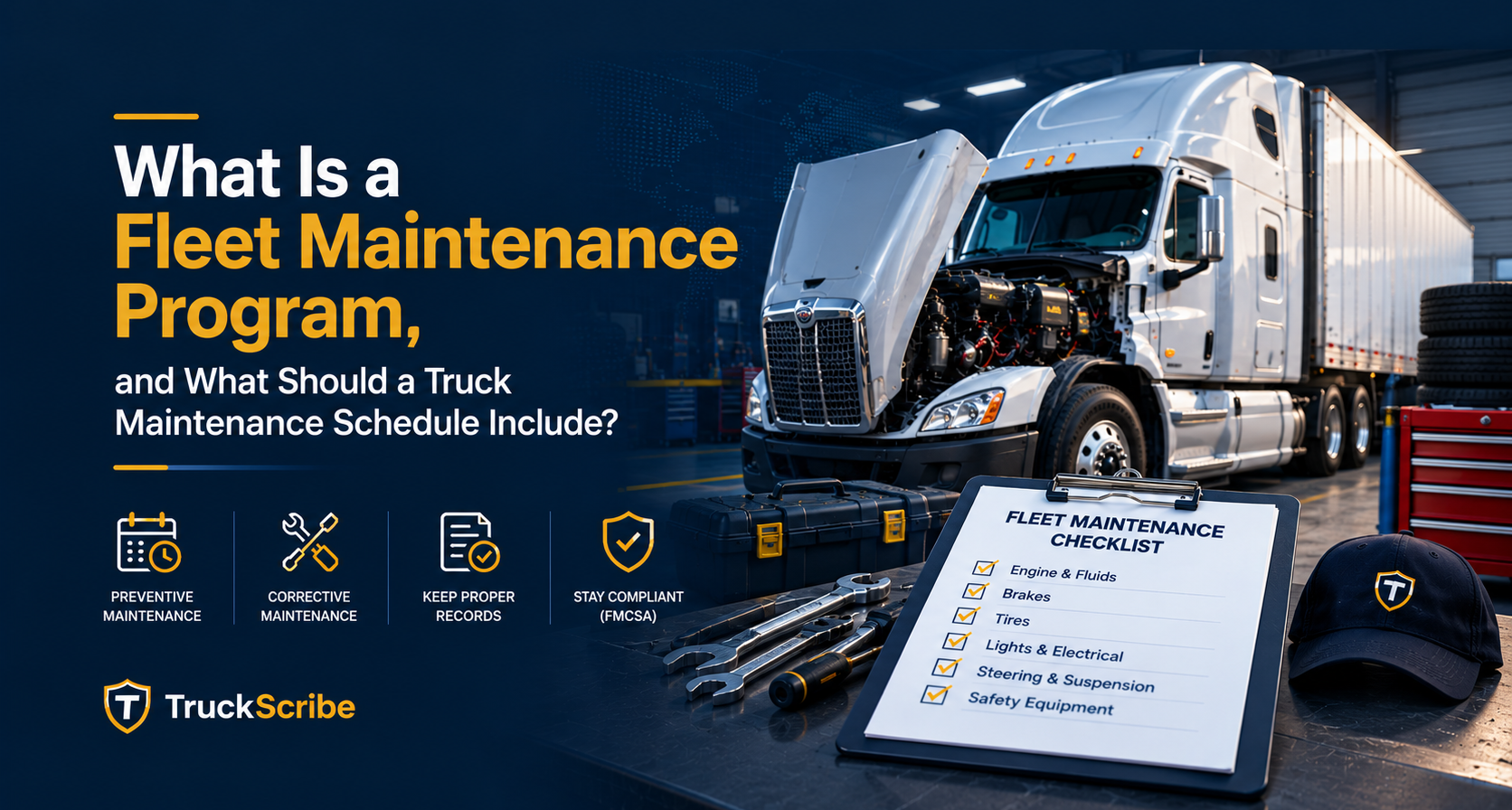
At its core, a fleet maintenance program combines preventive maintenance, which is planned service performed on a schedule, with corrective maintenance, which addresses problems as they come up. Documentation ties the two together, since every inspection, repair, and service needs a paper or digital record showing it happened.
A well-run program is less about hitting perfection and more about predictability. A carrier that knows exactly when each truck is due for service, and keeps a clean record of what was done, avoids the kind of surprise breakdown that costs far more in towing, missed deliveries, and downtime than the maintenance itself ever would have.
The distinction between the two maintenance types matters more than it first appears. A fleet running almost entirely on corrective maintenance, fixing things only after they break, tends to spend significantly more over time than one that catches problems early. Downtime from an unplanned breakdown also costs more than the repair itself, once towing, missed deliveries, and idle driver time are factored in.
What FMCSA Actually Requires
The federal requirement comes from 49 CFR 396.3, which states that every motor carrier must systematically inspect, repair, and maintain all vehicles under its control, and that a vehicle should not be operated in a condition likely to cause an accident or a breakdown.
What the regulation does not do is specify exactly what that system has to look like. FMCSA requires a systematic program but leaves the specific schedule, intervals, and procedures up to each carrier. This is part of why maintenance history matters so much during a DOT audit, since an auditor is evaluating whether a carrier's program is genuinely systematic, not comparing it against one fixed federal checklist.
This flexibility can work against a carrier that treats it as an excuse to do less. A vague or inconsistent program is much harder to defend during a review than a clearly documented one, even if both carriers technically comply with the letter of the rule.
What a Truck Maintenance Schedule Should Include
A complete schedule typically layers together a few different types of checks, each catching different kinds of problems.
Daily Pre-Trip and Post-Trip Inspections
Drivers check brakes, lights, tires, mirrors, fluid levels, and safety equipment before and after every trip. This is the fastest way to catch a developing problem before it becomes a roadside violation or a breakdown mid-route.
Scheduled Interval Services
Oil changes, tire rotations, brake inspections, and fluid checks happen at set mileage or time intervals, based on manufacturer guidance and how hard a specific truck is worked. A truck running long-haul routes typically needs a tighter interval than one used for short, local runs.
Annual Inspections
A more thorough, periodic inspection pulls each vehicle out of service to check systems that daily inspections would not catch, including a deeper look at brakes, steering, and structural components.
How Often Should Maintenance Happen
There is no single federal interval that applies to every truck, which is exactly why the regulation calls for a systematic program rather than a fixed schedule. Mileage, engine hours, cargo type, and route conditions all factor into how often a specific truck needs service.
A refrigerated trailer running temperature-sensitive freight typically needs more frequent checks on its cooling system than a dry van hauling general freight. A carrier building its own schedule usually starts with manufacturer recommendations, then adjusts based on how its trucks actually perform in the field over time.
Trailers generally follow their own service tiers separate from the tractor pulling them. A basic trailer inspection covering lights, tires, brakes, and coupling devices might run every few months, while a more thorough trailer service, including deeper checks of axles and safety equipment, happens on a longer, typically annual cycle.
What Happens If Maintenance Records Are Incomplete
Incomplete or missing maintenance records carry real consequences beyond a single roadside citation. FMCSA can issue fines for failure to maintain vehicles under 49 CFR 396.3, and if an out-of-service order is issued and the carrier continues operating the vehicle anyway, penalties escalate significantly.
Maintenance gaps are also one of the patterns auditors specifically look for. A carrier with thin or inconsistent records is harder pressed to demonstrate a functioning safety management system during a DOT audit, and mechanical violations found during inspections feed directly into a carrier's Vehicle Maintenance BASIC score under the broader CSA score system.
Brake and tire issues are worth flagging specifically, since they account for a disproportionate share of large truck crashes tied to mechanical failure. A carrier with recurring violations in either category is likely to see that pattern reflected clearly across its safety scores, well before it ever escalates to a formal audit.
How Maintenance History Affects a Carrier's Reputation
A poor maintenance record does not stay contained to compliance paperwork. Insurers reviewing commercial trucking insurance applications increasingly factor in a carrier's Vehicle Maintenance BASIC score, since mechanical failures are a leading cause of preventable accidents.
Brokers evaluating a carrier for a load often check the same data. Freight brokers have a real incentive to avoid tendering freight to a carrier with a documented pattern of maintenance-related violations, since that carrier represents a higher risk of a missed delivery or an accident that could expose the broker to liability.
Building a Maintenance Schedule That Scales
A single-truck owner-operator can often manage maintenance with a simple spreadsheet or a paper log, tracking service dates and mileage by hand without much overhead.
A growing fleet needs more structure. Once a carrier is managing multiple trucks across different routes, tracking service intervals manually becomes error-prone, and a missed service on even one truck can trigger a violation that affects the carrier's overall safety profile the way TruScore weighs a carrier's broader safety posture when grading it for outside parties evaluating the business.
Digital fleet maintenance software has become the standard response to this scaling problem, tracking due dates automatically and generating the documentation an auditor would ask for without requiring a fleet manager to reconstruct records by hand under deadline pressure.
The transition point varies by carrier, but most operators notice the strain somewhere between five and ten trucks, when a spreadsheet stops being enough to reliably flag every upcoming service date across a growing fleet. Waiting too long past that point tends to be when the first missed service, and the violation that follows it, actually happens.
Frequently Asked Questions
How long must maintenance records be kept?
FMCSA generally requires maintenance records to be kept for at least one year while a vehicle is in service, and a minimum of six months after it is taken out of service. Many carriers keep records longer than the minimum simply because the documentation supports insurance and resale value as well.
Does FMCSA require a specific maintenance schedule?
No. The regulation requires a systematic program but does not mandate specific intervals or procedures, leaving carriers to build a schedule that fits their own fleet and operating conditions.
What's the difference between preventive and corrective maintenance?
Preventive maintenance is planned service performed on a schedule to catch problems before they cause a failure. Corrective maintenance is the repair work done after something has already broken or been flagged during an inspection.
Can outdated maintenance records trigger a DOT audit?
Maintenance records themselves are not typically what triggers an audit, but the underlying violations that come from poor maintenance, like mechanical roadside citations, do factor into what triggers one. A pattern of maintenance-related violations is one of the more common reasons a DOT audit gets scheduled in the first place.
Do owner-operators need a formal maintenance program?
Yes. The federal requirement applies regardless of fleet size, so a single-truck owner-operator is held to the same underlying standard as a large carrier, even if the actual system used to track it looks much simpler in practice. For businesses tracking maintenance history across an entire carrier network, TruckScribe keeps safety and compliance data current in one place, rather than requiring a fresh manual check on every carrier a business works with.
The simplicity of a one-truck operation does not lower the bar, it just changes what compliance looks like day to day. A consistent paper log kept faithfully can satisfy the same systematic requirement that a large fleet meets with dedicated software, as long as the underlying inspections and repairs are actually happening on schedule