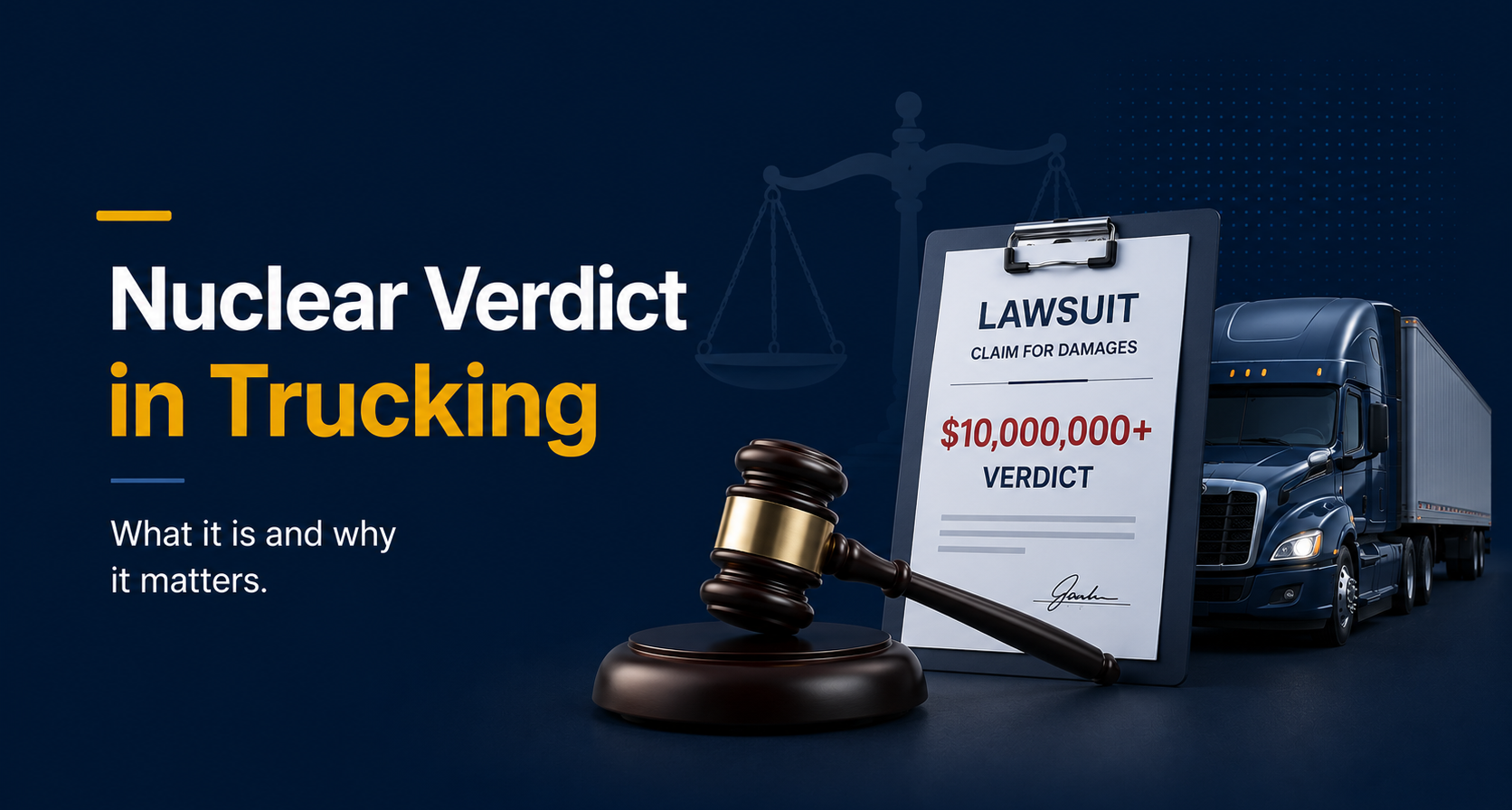
A nuclear verdict is a jury award in a lawsuit that far exceeds what the actual damages would reasonably justify, typically defined as a verdict of $10 million or more. In trucking, these verdicts usually come out of accident litigation, and they have become one of the biggest drivers behind rising commercial insurance premiums across the industry.
The term itself is not new, but the frequency and size of these awards have grown sharply in recent years. For carriers, understanding what triggers a nuclear verdict, and what makes a company a bigger target for one, has become a genuine business consideration rather than a distant legal concern.
What Is a Nuclear Verdict?
A nuclear verdict describes a jury award so large that it goes well beyond compensating an accident victim for actual, provable losses like medical bills or lost income. Legal and insurance analysts generally use $10 million as the threshold, though some verdicts in trucking litigation have reached well into the tens or even hundreds of millions.
These awards are distinct from ordinary settlements or judgments. A verdict becomes nuclear when the amount reflects punishment or a message to an industry, rather than a straightforward calculation of harm. This distinction matters for commercial trucking insurance, since insurers price coverage based partly on the risk of exactly this kind of outlier outcome.
Why Nuclear Verdicts Are Becoming More Common
Several forces have combined to push verdict sizes upward over the past decade, and none of them show signs of slowing down.
Third-party litigation funding has grown significantly, allowing plaintiffs' attorneys to pursue larger, more resource-intensive cases against trucking companies with the financial backing to sustain a long court battle. At the same time, public sentiment toward large corporations has shifted, and jurors increasingly view a trucking company as a well-resourced business capable of absorbing a massive award.
Attorneys have also become more sophisticated in how they present a case, often framing an accident as evidence of a broader pattern of corporate negligence rather than an isolated incident. This shift in courtroom strategy is a major reason verdict sizes have grown even in cases where the underlying facts are similar to smaller cases from years past.
Social media and public case tracking have added another layer as well. High-profile verdicts now circulate widely within the legal community almost immediately, and that visibility tends to encourage similar strategies in future cases, since attorneys can point to recent, successful outcomes as a benchmark for what a jury might be willing to award.
How Nuclear Verdicts Affect Trucking Insurance Rates
Insurers price commercial trucking coverage based on the likelihood and potential size of a claim. As nuclear verdicts have become more frequent, insurers have had to account for outlier outcomes that used to be rare exceptions, not a real possibility factored into every policy.
This shows up directly in premiums. Carriers across the industry, not just those who have faced litigation themselves, are absorbing higher rates because insurers spread the cost of nuclear verdict risk across their entire book of business. Some insurers have also pulled back from covering higher-risk carrier profiles entirely, shrinking the pool of available coverage options and pushing remaining prices even higher.
What Typically Leads to a Nuclear Verdict
Not every accident case results in an outsized award. A handful of recurring factors tend to appear in the cases that do.
A Serious Accident with Preventable Causes
Cases involving a fatality or catastrophic injury carry more weight with a jury from the start, and the presence of a preventable cause, such as fatigue or a maintenance failure, strengthens the argument that the outcome was avoidable.
A Carrier's Safety Record Becomes Evidence
A carrier's history of violations, prior accidents, or a downgraded rating from a DOT audit can be introduced as evidence of a pattern rather than a one-time failure. This is part of why a documented, clean compliance history matters well beyond passing a single inspection.
Reptile Theory and Jury Persuasion Tactics
A well-known plaintiff's attorney strategy frames a case around community safety rather than the specific plaintiff's damages, encouraging jurors to see their verdict as protecting future potential victims. This approach has been credited with contributing to some of the largest awards seen in trucking litigation.
Which Carriers Are Most at Risk
Larger fleets with more trucks on the road carry more statistical exposure simply through higher mileage and more driving hours. But size alone does not determine risk. A carrier with gaps in its driver qualification files, inconsistent carrier vetting practices, or a pattern of unresolved safety violations presents a more attractive target for plaintiffs' attorneys building a negligence case, regardless of fleet size.
New authorities face a particular version of this risk. Without an established track record, a new carrier's practices and documentation get scrutinized closely if litigation ever arises, since there is less history to demonstrate a consistent safety culture.
Carriers operating in states known for plaintiff-friendly courts also face a different risk calculation than those operating primarily in more conservative jurisdictions. Where an accident occurs, and which court ultimately hears the case, can meaningfully influence the size of an eventual verdict even when the underlying facts are nearly identical to a case decided elsewhere.
How Carriers Can Reduce Nuclear Verdict Risk
While no carrier can eliminate litigation risk entirely, a handful of practices consistently reduce exposure.
Maintain Clean Safety and Compliance Records
Consistent, well-documented compliance history undercuts the pattern-of-negligence argument that fuels many large verdicts. This includes staying current on inspections, maintenance logs, and hours of service records.
Address Driver Qualification Gaps Early
Incomplete driver files are one of the most commonly cited issues in post-accident litigation. Reviewing qualification files regularly, rather than only when a new driver is hired, closes a gap that plaintiffs' attorneys actively look for.
Work with Insurers Who Understand Trucking Risk
An insurer familiar with trucking-specific litigation trends is better positioned to guide a carrier toward practices that reduce exposure, rather than simply pricing risk after the fact. This is also where TruScore becomes useful for anyone assessing a carrier's standing, since a graded safety posture reflects exactly the kind of pattern a plaintiff's attorney would otherwise dig up manually.
What This Means for the Broader Trucking Industry
Rising premiums driven by nuclear verdict risk create a real barrier to entry for new carriers, who already face tighter underwriting standards than established fleets. This dynamic connects directly to what insurance agencies are seeing industry-wide, as underwriters grow more selective about which new authorities they are willing to cover at all.
Some smaller carriers are being priced out of coverage entirely, accelerating industry consolidation as larger, better-capitalized fleets absorb the freight volume left behind. The long-term effect is a trucking industry with fewer, larger players, a shift that traces back in part to the same litigation trend driving nuclear verdicts in the first place.
Frequently Asked Questions
What is the legal threshold for a nuclear verdict?
Most legal and insurance analysts use $10 million as the general threshold, though there is no single official legal definition. According to the U.S. Chamber of Commerce Institute for Legal Reform, the term is widely used across the legal industry to describe awards that far exceed what actual damages would justify.
Are nuclear verdicts only a trucking industry problem?
No, nuclear verdicts occur across many industries, including medical malpractice and product liability cases. Trucking has drawn particular attention because commercial vehicle accidents often involve catastrophic injuries and because trucking companies are seen by juries as well-resourced defendants.
Can a small carrier be hit with a nuclear verdict?
Yes. Verdict size is driven more by the facts of the accident and the litigation strategy used than by the size of the defendant carrier. A small fleet with a serious accident and documentation gaps can face the same exposure as a large one.
Does a clean safety record protect a carrier from lawsuits?
A clean record does not prevent a lawsuit from being filed, but it significantly weakens the pattern-of-negligence argument that tends to drive the largest verdicts. It also gives a carrier's defense a much stronger position if a case does go to trial.
How do insurers respond to a rise in nuclear verdicts?
Insurers typically raise premiums across their book of business, tighten underwriting standards, and in some cases pull back from covering higher-risk carrier profiles altogether. For teams tracking how these shifts affect the carriers they work with, TruckScribe keeps authority, safety, and compliance data current in one place, rather than requiring a fresh manual check every time a carrier's standing might have changed.