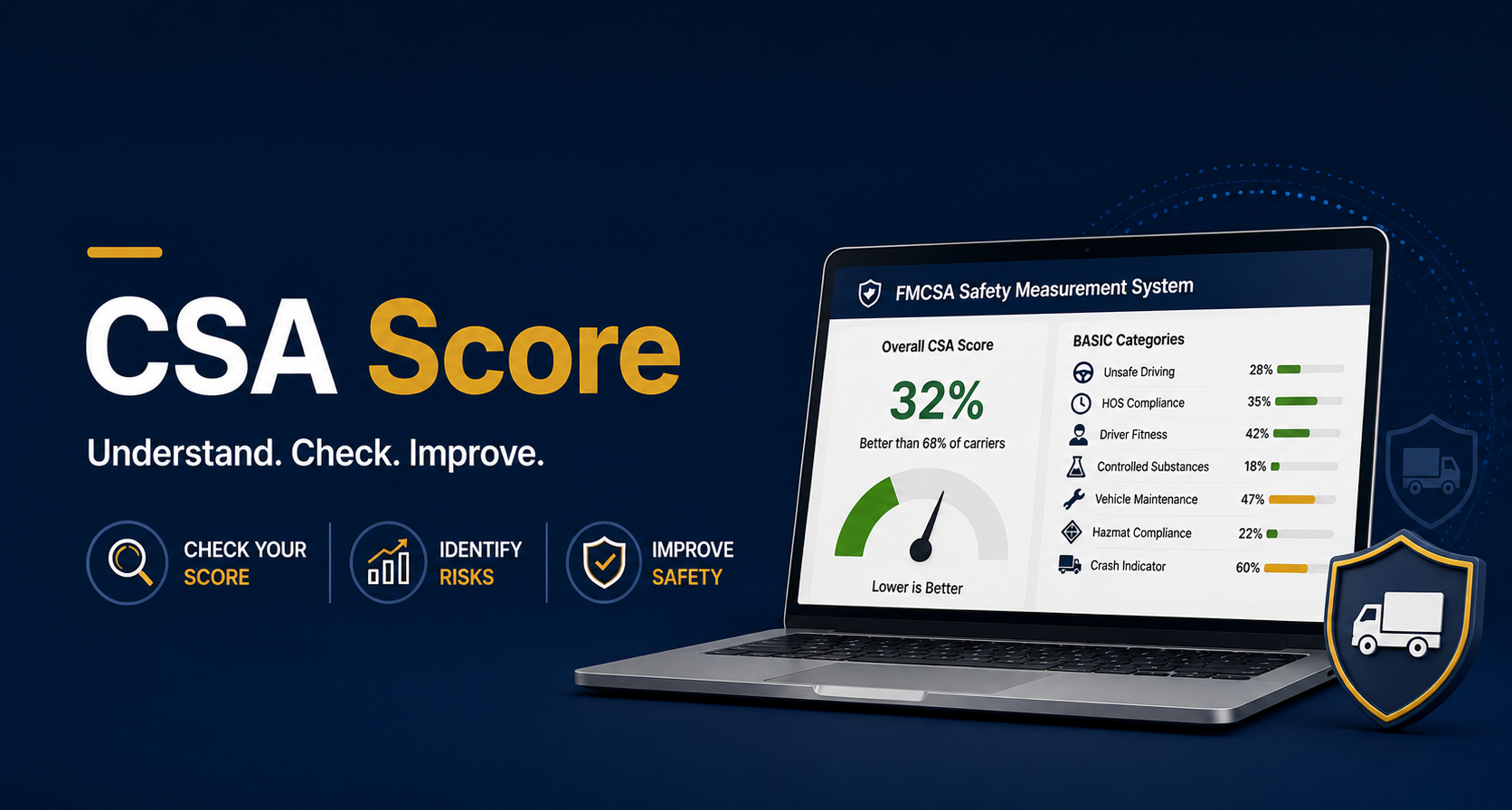
A CSA score is a percentile ranking the FMCSA uses to compare a motor carrier's safety performance against similar carriers. Scores range from 0 to 100, with lower numbers being better, and they are calculated separately across seven distinct safety categories rather than as one single number.
The score comes from the FMCSA's Compliance, Safety, Accountability program, introduced in 2010 to catch safety risks earlier than the agency's older SafeStat system allowed. For a carrier, a CSA score affects everything from insurance rates to how often trucks get pulled over for inspection.
What Is a CSA Score?
CSA stands for Compliance, Safety, Accountability, and it refers to both the FMCSA's overall safety monitoring program and the scores that program produces. The scores themselves come from the Safety Measurement System, which pulls data from roadside inspections, crash reports, and violation history over a rolling 24-month window.
A CSA score is not the same thing as a DOT safety rating. A safety rating (Satisfactory, Conditional, or Unsatisfactory) only gets issued after a formal compliance review, and most carriers never receive one. A CSA score, by contrast, updates continuously and applies to nearly every carrier operating in interstate commerce, regardless of whether a formal review has ever taken place.
The program itself was introduced in 2010, replacing an older system called SafeStat. The goal was to catch developing safety risks earlier, before they escalate into a crash, by giving regulators a continuously updated view of carrier performance rather than relying only on periodic reviews.
The Seven BASIC Categories
CSA scores are broken into seven categories, known as BASICs, short for Behavior Analysis and Safety Improvement Categories. Each one tracks a different type of safety risk.
Unsafe Driving
This category covers dangerous or careless operation, including speeding, reckless driving, improper lane changes, and failure to wear a seatbelt.
Hours of Service Compliance
This tracks violations related to driving while fatigued or exceeding federal hours of service limits, which is also the exact data an ELD is built to record automatically.
Driver Fitness
This measures whether drivers hold valid licensing and meet medical qualification requirements to legally operate a commercial vehicle.
Controlled Substances and Alcohol
This covers violations related to operating a vehicle while impaired by alcohol, illegal drugs, or misused prescription medication.
Vehicle Maintenance
This tracks mechanical violations found during inspections, including brake issues, tire condition, and lighting defects.
Hazardous Materials Compliance
This applies specifically to carriers hauling regulated hazardous materials, covering proper labeling, placarding, and handling procedures.
Crash Indicator
This tracks a carrier's crash history based on state-reported data, regardless of who was found at fault in the incident.
How a CSA Score Is Calculated
Each BASIC category converts a carrier's violation and crash history into a percentile ranking, comparing that carrier against peers of similar size and operation type. A higher percentile means worse relative performance, since the score measures standing against comparable carriers rather than an absolute count of violations.
Severity and recency both affect the weighting. A violation from last month counts more heavily than one from eighteen months ago, and a more dangerous violation type carries a higher severity weight than a minor one. This is why two carriers with the same number of total violations can end up with noticeably different scores.
Peer grouping also matters more than most carriers realize. A small fleet running a handful of trucks is compared against other small fleets, not against a national carrier running thousands of trucks. This keeps the ranking relatively fair across very different scales of operation, though it also means the same violation can move a small carrier's percentile more sharply than it would for a much larger one.
What Counts as a Good or Bad CSA Score
Each BASIC category has its own intervention threshold, the percentile at which the FMCSA flags a carrier for potential enforcement action. Most categories use a 65 percent threshold, though hazardous materials carriers face a stricter 80 percent threshold given the higher stakes involved.
Crossing that threshold in two or more categories is generally treated as a signal of elevated risk, both by the FMCSA and by outside parties evaluating a carrier. A carrier's standing here often factors into what triggers a DOT audit, since a pattern across multiple BASICs is one of the most common reasons a compliance review gets scheduled.
How to Check Your CSA Score for Free
The FMCSA's Safety Measurement System provides free public access to CSA data. A carrier can look up its own scores using its USDOT number, and the public view also allows brokers, shippers, and insurers to check a carrier's standing before doing business with them.
Individual drivers do not have their own separate public CSA score in the same sense a carrier does, though a driver's violations do feed into the carrier's overall scores while that driver is on the payroll. Checking company-level data through the SMS remains the most direct way to see where a carrier actually stands.
How to Improve a Bad CSA Score
A high score is rarely permanent, and most carriers can bring their standing down with consistent, targeted effort.
The timeline for improvement varies by category. A single clean inspection can help immediately, but meaningfully lowering a percentile usually takes several months of consistent performance, since older violations only fall out of the 24-month window gradually rather than all at once.
Address the Root Cause
Identifying which specific BASIC is driving the problem matters more than treating the score as one undifferentiated number. A carrier with a Vehicle Maintenance problem needs a different fix than one struggling with Hours of Service compliance.
Dispute Inaccurate Violations Through DataQs
The FMCSA's DataQs system allows carriers to formally challenge violations they believe were recorded incorrectly. A successful dispute removes the violation from the score calculation entirely, rather than simply aging it out over time.
Stay Ahead With Regular Monitoring
Since scores update continuously on a rolling window, checking in regularly catches problems while they are still small. This is part of why carrier vetting on the broker and insurance side increasingly treats CSA data as a live signal rather than something to check once and forget.
How a CSA Score Affects Your Business
A high CSA score rarely stays contained to compliance paperwork. Commercial trucking insurance rates often climb once a carrier crosses an intervention threshold, since insurers price risk based partly on exactly this data. Brokers and shippers making booking decisions frequently pull the same numbers before offering a load, since a carrier's safety standing has become a routine part of vetting.
There is also a less obvious risk. A carrier's documented safety history, including its CSA standing, can become evidence in litigation following a serious accident. This is part of what feeds into a nuclear verdict, where a pattern of unresolved violations strengthens a plaintiff's argument that an accident was foreseeable rather than a one-time failure.
Frequently Asked Questions
Do individual drivers have their own CSA score?
Not in the same public sense a carrier does. A driver's violations feed into whichever carrier they are working for at the time, and that history can follow the driver informally through employment screening, but there is no separate public-facing driver score the way there is for carriers.
How long do violations stay on a CSA score?
Violations remain in the calculation for 24 months from the date of the violation, with more recent violations weighted more heavily than older ones within that window.
Can a CSA score affect my insurance rates?
Yes. Insurers commonly review CSA data as part of underwriting, and a carrier with scores above the intervention threshold in multiple categories often faces higher premiums. This is one of several factors insurance agencies weigh when quoting a new or existing account.
Is a CSA score the same as a DOT safety rating?
No. A CSA score is an ongoing percentile measurement across seven categories, while a DOT safety rating is a formal Satisfactory, Conditional, or Unsatisfactory determination issued only after a compliance review. Most carriers have CSA scores without ever having received a formal safety rating.
How often is a CSA score updated?
The underlying data refreshes on a regular basis as new inspection and crash reports come in. For businesses tracking multiple carriers at once, TruScore factors safety posture, including this kind of ongoing FMCSA data, into a single grade, rather than requiring a fresh manual check for every carrier on a growing list.
Keeping track of CSA standing across an entire carrier network gets harder as that network grows. TruckScribe keeps authority, safety, and compliance data current in one place, so a change in a carrier's standing shows up without a manual lookup every time.