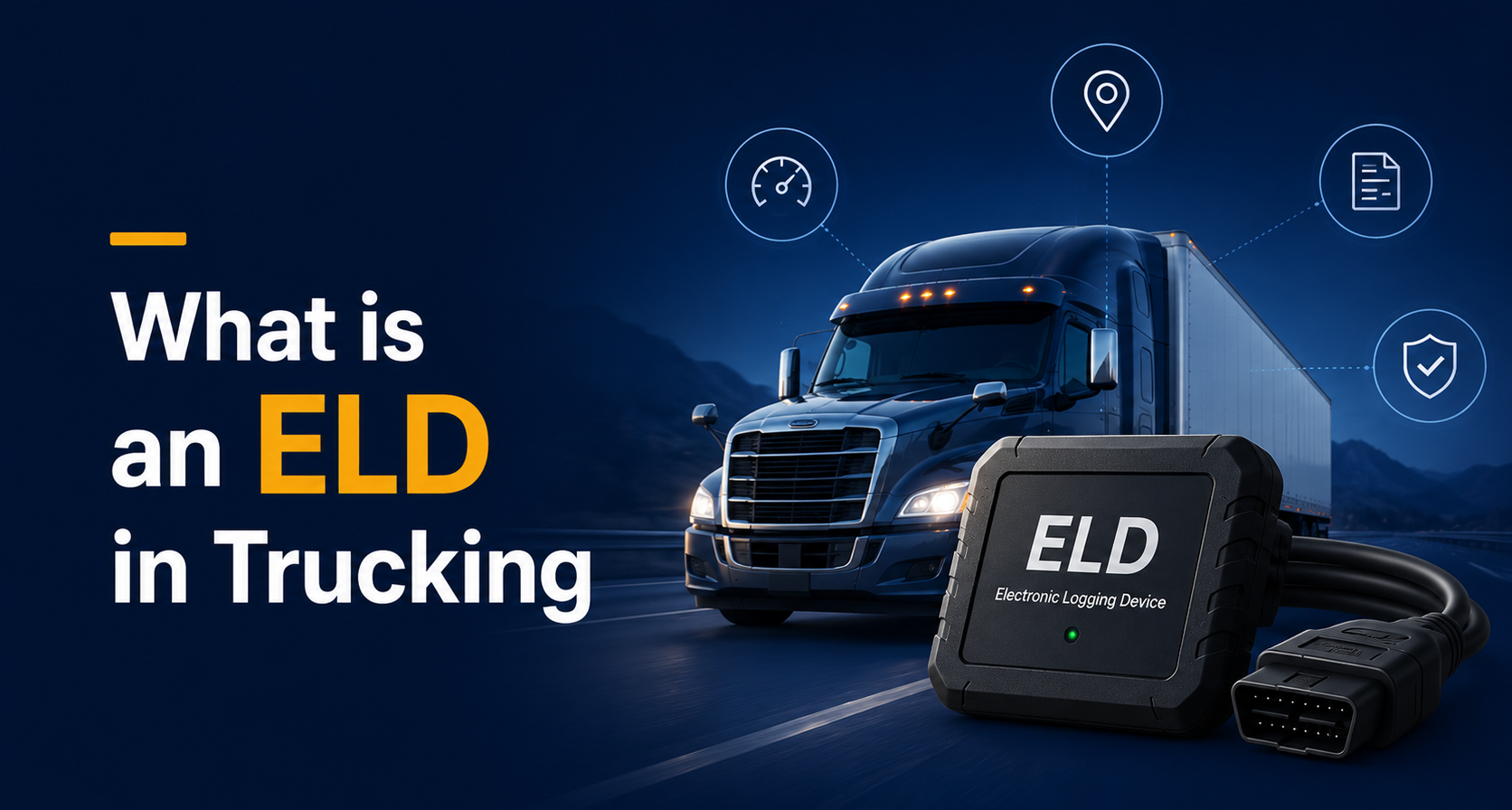
An ELD, or electronic logging device, is hardware that connects to a commercial truck's engine and automatically records a driver's hours of service. It replaced the paper logbooks that drivers once filled out by hand, and it's now required under a federal mandate for most commercial motor vehicle operators in the United States.
The ELD mandate exists to ensure hours-of-service records are accurate and tamper-resistant. Before ELDs, a driver could write down whatever hours they wanted on a paper log, and there was no reliable way to verify it. An ELD removes that gap by syncing directly with the vehicle's engine.
What Is an ELD?
An ELD is a small device, usually connected to the truck's diagnostic port, that automatically tracks driving time as soon as the engine starts. It records when a driver is on duty, off duty, driving, or in a sleeper berth, and it keeps that record synced to a central system that can be pulled up during a roadside inspection.
Unlike a paper logbook, an ELD cannot simply be filled in after the fact. It captures data in real time directly from the vehicle, which is what makes it useful both for compliance and for catching hours of service violations before they become a safety issue.
This same shift toward verifiable, real-time records shows up across FMCSA compliance generally, including how a carrier vetting process now leans on live data instead of paperwork a carrier could simply hand over.
Why the ELD Mandate Exists
The ELD mandate was established under the FMCSA's Hours of Service rule, built on authority granted by the 2012 MAP-21 transportation law. The rule phased in nationwide starting December 2017, with a final deadline in December 2019 for carriers that had been using older recording devices.
The goal was reducing fatigue-related crashes by making hours of service violations harder to hide. Paper logs were notoriously easy to falsify, and a driver under pressure to make a delivery had every incentive to underreport hours behind the wheel. An ELD removes that incentive by recording the truth automatically.
The mandate also closed a loophole that had existed for years. Before ELDs, two drivers running the same route could report wildly different hours for identical trips, and there was no reliable way for an inspector or a safety manager to know which log, if either, reflected reality. Automatic recording removed that ambiguity almost entirely.
What an ELD Actually Records
An ELD captures several categories of data every time a truck is in operation, and each one plays a different role in compliance and safety.
Hours of Service (HOS)
This is the core function of the mandate. An ELD tracks driving time, on-duty time, off-duty time, and sleeper berth time, then compares that against the federal hours of service limits to flag violations automatically.
Vehicle and Engine Data
Most ELDs also record engine hours, ignition status, vehicle movement, and odometer readings. This data confirms the truck was actually in motion during the recorded driving time, rather than relying on a driver's word alone.
Location Data
An ELD logs GPS location at set intervals throughout a shift, which supports the hours of service record and gives inspectors a way to confirm a driver's reported route matches where the truck actually was.
Who Does the ELD Mandate Apply To?
The mandate applies to most drivers required to keep records of duty status, which covers the majority of commercial motor vehicle operators in interstate commerce. This includes company drivers, owner-operators, and fleets of any size, from a single truck to a large carrier.
If a driver would otherwise be filling out a paper logbook to track hours of service, they almost certainly fall under the ELD mandate. The rule applies regardless of whether the truck is company-owned or independently operated, since the requirement is tied to the driving activity, not the ownership structure.
This is one of the first compliance requirements a new authority runs into, often alongside its FMCSA new entrant safety audit, since both are early checkpoints the FMCSA uses to confirm a new carrier is operating safely from day one.
This is also the exact window when ELD providers are racing to reach a new carrier, since every authority that clears registration needs a certified device before its first load ships.
Who Is Exempt From the ELD Mandate?
A handful of specific situations fall outside the mandate, and understanding them matters just as much as understanding who's covered.
Short-Haul Exemption
Drivers who operate within a 150 air-mile radius of their normal work location and return to the same location within 14 hours generally qualify for a short-haul exemption, since they're already exempt from detailed hours of service logging in most cases.
Pre-2000 Vehicle Exemption
Trucks with engines manufactured before model year 2000 are exempt from the ELD requirement, since these older engines often lack the technology needed to interface with an ELD reliably.
Driveaway-Towaway Exemption
Drivers transporting a vehicle as the commodity being delivered, such as moving a truck from a factory to a dealership, are exempt when the vehicle being driven is itself the shipment.
Infrequent Paper Log Exemption (8-Day Rule)
A driver who uses paper logs no more than 8 days out of any 30-day period can continue doing so without an ELD, which covers drivers who only occasionally need to log hours of service.
What Happens If a Carrier Isn't Compliant?
A driver operating without a required ELD, or with one that isn't functioning correctly, can be placed out of service during a roadside inspection. This means the truck stops moving until the violation is resolved, which costs a carrier both time and money on top of any fine.
Beyond the immediate inspection consequence, ELD violations affect a carrier's CSA score, the FMCSA's safety rating system. A pattern of violations can lead to increased inspection frequency and, in serious cases, intervention from the FMCSA that threatens a carrier's operating authority.
Repeated violations also tend to show up in how outside parties see a carrier. A TruScore grade, for example, factors in safety posture built from exactly this kind of FMCSA record, so a pattern of ELD violations can affect how a carrier looks to a broker or insurer long before the FMCSA itself intervenes.
ELD vs AOBRD: What Changed
Before the ELD mandate, many carriers used AOBRDs, or automatic onboard recording devices, to track hours electronically. AOBRDs recorded basic information like mileage and location but lacked the more detailed engine and diagnostic data that ELDs capture.
The key difference is depth of data and tamper resistance. An AOBRD could still be edited more freely by a driver or fleet manager, while an ELD locks certain data points to prevent after-the-fact changes. Carriers using AOBRDs before the mandate had until December 2019 to fully transition to ELDs.
According to the Federal Motor Carrier Safety Administration, every certified ELD must also support at least one standardized method for transferring data to a safety official on demand, either through a telematics-type transfer or a local USB and Bluetooth connection, a requirement AOBRDs were never held to.
Frequently Asked Questions
When did the ELD mandate take effect?
The rule phased in starting December 2017 for most carriers, with a final compliance deadline in December 2019 for carriers still transitioning from older AOBRD systems. Carriers that missed the final deadline faced the same out-of-service risk as any other ELD violation, regardless of how long they had been compliant with the older AOBRD standard.
Do owner-operators need an ELD?
Yes, in most cases. The mandate applies based on the driving activity and hours of service recordkeeping requirement, not on whether the truck is owned by a large fleet or a single independent operator. An owner-operator hauling under their own authority is held to the exact same standard as a driver working for a large carrier.
Can an ELD be challenged or disputed during an inspection?
A driver can dispute specific data points through the FMCSA's DataQs system after the fact, but during a live roadside inspection, the ELD record is generally treated as the authoritative source for hours of service. Disputing a record after an inspection does not undo an out-of-service order issued at the time.
What's the difference between an ELD and a telematics system?
An ELD is specifically built and certified to meet the FMCSA's hours of service recording requirements. Telematics is a broader category of connected vehicle technology that can include GPS tracking, driver behavior monitoring, and fleet analytics, and many modern ELDs are built on top of a telematics platform, bundling compliance with a wider set of fleet management features.
Is the ELD mandate the same in Canada?
No. Canada has its own ELD mandate under Transport Canada with a separate certification process and timeline, and a device certified for the US mandate isn't automatically valid for Canadian compliance. A carrier running cross-border routes typically needs a device certified under both standards to stay compliant on either side of the border.