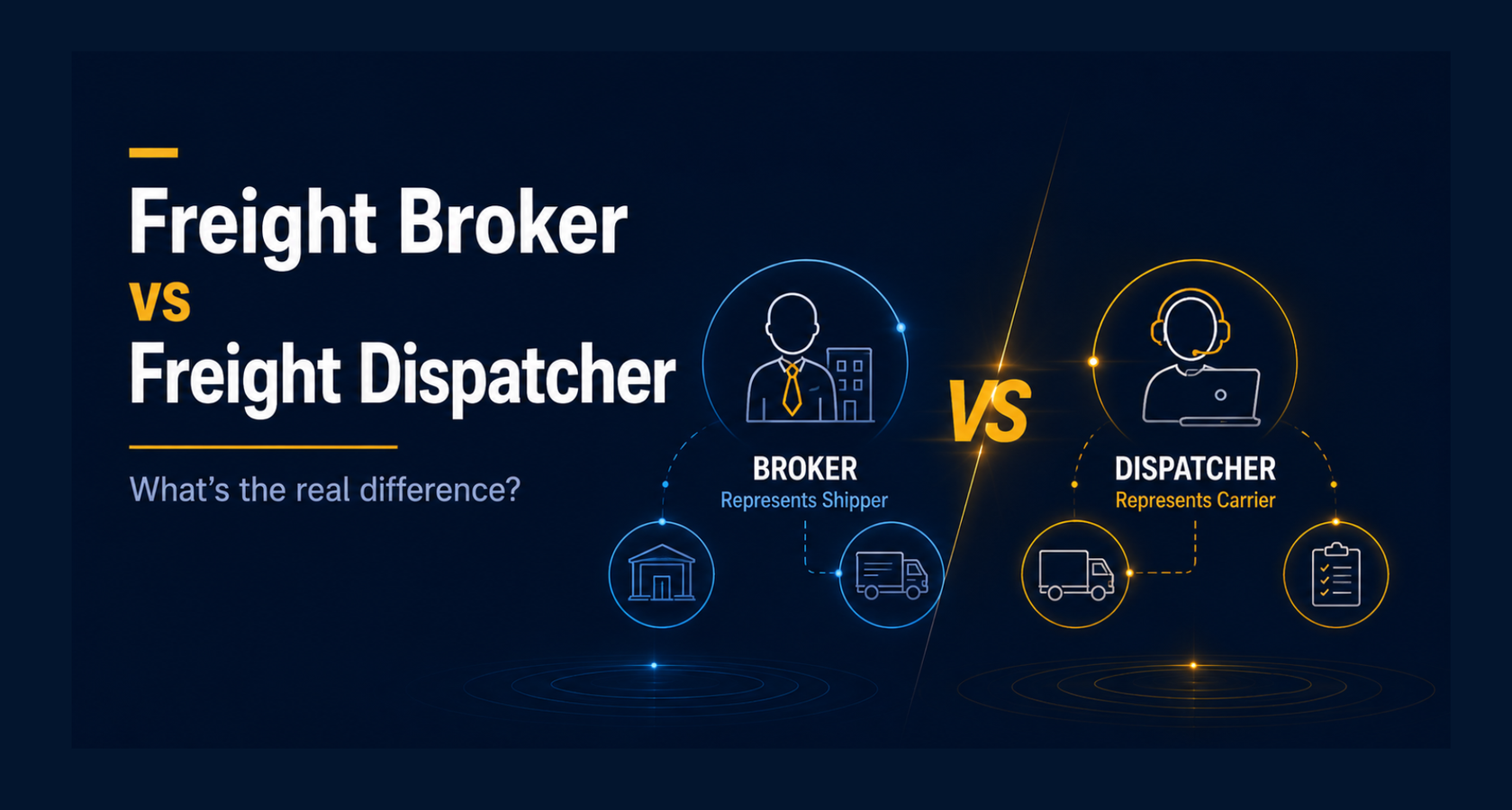
New carriers hear both terms within their first week of getting authority, and the two get confused constantly. A freight broker and a freight dispatcher can both help a truck find work, but they represent opposite sides of the same transaction, get paid in different ways, and operate under completely different rules, understanding which one does what changes how a carrier decides who to work with.
What Is a Freight Broker?
A freight broker is a licensed intermediary who works on behalf of the shipper. A company that needs freight moved posts that load with a broker, and the broker's job is to find a qualified carrier to haul it, negotiate the rate, and manage the transaction from pickup to delivery.
Brokers hold a separate FMCSA operating authority from carriers, and they're required to carry a surety bond or trust fund, known as a BMC-84 filing, before they can legally operate. This financial backing protects shippers and carriers if a broker fails to pay. A full breakdown of what this authority actually involves is covered in the guide on USDOT number vs MC number.
What Is a Freight Dispatcher?
A freight dispatcher works on behalf of the carrier, not the shipper. A trucking company or owner-operator hires a dispatcher to find loads, negotiate rates with brokers, and handle much of the back-office coordination that comes with keeping a truck moving.
Unlike brokers, dispatchers are not required to hold any special FMCSA license or bond. Dispatching is an unregulated service, which means the quality and professionalism of dispatchers varies significantly from one to the next.
The Core Difference - Who Each One Represents
The simplest way to understand the difference comes down to loyalty. A broker's job is to get the shipper's freight moved at the best possible terms for the shipper. A dispatcher's job is to get the carrier the best possible rate and the smoothest possible operation for the carrier.
They can end up negotiating directly with each other on the same load, but they're never working for the same side of the deal.
How Each One Gets Paid
Pay structure is one of the clearest ways to tell the two roles apart, since each one earns money from a different side of the transaction.
Freight Broker Pay Structure
A broker earns the difference between what the shipper pays for the load and what the broker pays the carrier to haul it. This margin typically runs between 15 and 25 percent of the shipper's rate, though it varies by lane, freight type, and market conditions.
Freight Dispatcher Pay Structure
A dispatcher typically earns a percentage of the carrier's gross revenue on each load, usually somewhere between 5 and 10 percent. Some dispatchers instead charge a flat weekly or monthly fee regardless of how many loads they book.
What Each One Actually Does Day to Day
The clearest way to see the difference between a broker and a dispatcher is to look at how each one actually spends the day. Both roles involve constant phone calls and negotiation, but the work itself points in opposite directions.
A Broker's Daily Tasks
A broker's day is built around moving freight for shippers while managing risk on every load. The core tasks stay consistent day to day, even though the specific loads and carriers change constantly.
- Posting loads on behalf of shippers and fielding calls from interested carriers
- Vetting carriers for active authority, insurance, and safety history before booking
- Negotiating rates that work for both the shipper and the carrier
- Tracking shipments from pickup through delivery
- Managing the shipper relationship and resolving issues if something goes wrong in transit
A Dispatcher's Daily Tasks
A dispatcher's day is built around keeping a carrier's trucks moving and profitable, which means constant coordination between load boards, brokers, and drivers.
- Searching load boards for freight that matches the carrier's equipment and lanes
- Calling brokers to negotiate rates on the carrier's behalf
- Planning routes around hours-of-service limits and delivery windows
- Coordinating directly with drivers on pickups, delays, and schedule changes
- Handling paperwork like rate confirmations, and in some cases managing invoicing or factoring submissions.
Licensing and Regulatory Differences
Beyond who each one represents, there's a real legal gap between the two roles. One is a federally regulated profession, and the other has no licensing requirement at all.
Freight Broker Authority Requirements
A broker must register for FMCSA broker authority, which is separate from motor carrier operating authority, and must maintain a $75,000 BMC-84 surety bond or trust fund. This is a federal requirement, and operating as a broker without it is illegal.
Why Dispatchers Are Unregulated
There is no federal license, bond, or authority requirement to operate as a freight dispatcher. Anyone can start a dispatching business with no oversight from the FMCSA, which is part of why due diligence matters when a carrier is choosing who to work with. This is the same kind of unregulated gap that shows up in chameleon carriers, where the absence of a required check becomes an opening for bad actors.
Can a Broker and a Dispatcher Work on the Same Load?
Yes, and this happens constantly. A carrier's dispatcher calls a broker to negotiate a load, agrees on a rate, and books it. The broker is representing the shipper's interest in that negotiation, while the dispatcher is representing the carrier's interest, and the load moves once both sides agree on terms.
Common Points of Confusion
The two roles get mixed up mainly because both involve finding freight, and both interact constantly with load boards and rate negotiations. The confusion usually clears up once someone understands the direction each one is working in: a broker sources capacity for a shipper, a dispatcher sources freight for a carrier.
Some new carriers also assume a dispatcher can act as their broker, which isn't accurate. A dispatcher works with brokers on the carrier's behalf, but does not hold broker authority and cannot post loads on a load board the way a broker does.
Which One Does a New Carrier Actually Need?
Most new carriers don't need a broker relationship at all in the traditional sense, since brokers work for shippers, not carriers. What a new authority typically needs is either a dispatcher, or the skills to self-dispatch using a load board directly.
This is also the exact window when a lot of vendors are trying to reach a brand-new carrier at once. A carrier vetting process matters just as much for a new carrier picking a dispatcher as it does for a carrier leads for freight brokers team vetting a carrier, since dispatching is unregulated and quality varies widely. On the dispatch side, a freight dispatcher leads team works this same new-authority window from the opposite angle, reaching carriers before they've settled on who handles their loads. Freight factoring is another service that often enters the picture around the same time, since a freight factoring team is typically reaching out to that same new carrier before its first invoice ever ships.
Every one of these teams, whether they're finding carriers, vetting them, or reaching them first, is working from the same underlying motor carrier database that tracks a carrier's authority the moment it goes active.
Frequently Asked Questions
Can a dispatcher also be a licensed freight broker?
Yes, but only if that dispatcher separately registers for FMCSA broker authority and secures a BMC-84 bond. Without that, a dispatcher is legally limited to representing carriers, not posting loads as a broker would.
Do I need both a dispatcher and a broker?
Not directly. A carrier typically hires a dispatcher, and that dispatcher is the one who ends up negotiating with brokers on the carrier's behalf. A carrier doesn't usually hire a broker themselves, since brokers work for the shipper side of the transaction.
Which one should a new owner-operator use first?
Most new owner-operators start with a dispatcher or handle load boards themselves, since brokers aren't something a carrier hires directly. The decision usually comes down to how much time a driver has to spend on rate negotiation versus driving.
Is a freight dispatcher regulated by the FMCSA?
No. Dispatching has no federal licensing or bonding requirement, which is different from freight brokering, where FMCSA broker authority and a surety bond are legally required.
Can a broker dispatch loads directly without a dispatcher?
A broker doesn't dispatch on behalf of a carrier. A broker posts and sources loads for a shipper. If a carrier wants help booking and negotiating loads, that's the role a dispatcher fills, not a broker.