Freight fraud costs the industry billions every year, and one of the oldest tactics behind it is a carrier that disappears and comes back wearing a disguise. Brokers, shippers, and factoring companies run into this problem constantly, often without realizing it until a load goes wrong. This is one of several patterns covered in the broader look at what freight fraud actually includes, but chameleon carriers deserve a closer look on their own.
The danger is that a company like this looks brand new on paper, with a clean record and no obvious history. By the time the warning signs surface, your cargo may already be on a truck run by people who were shut down for a reason.
This guide walks through what these carriers are, why they do it, the signals that give them away, and the simple checks that keep them off your loads.
What Is a Chameleon Carrier?
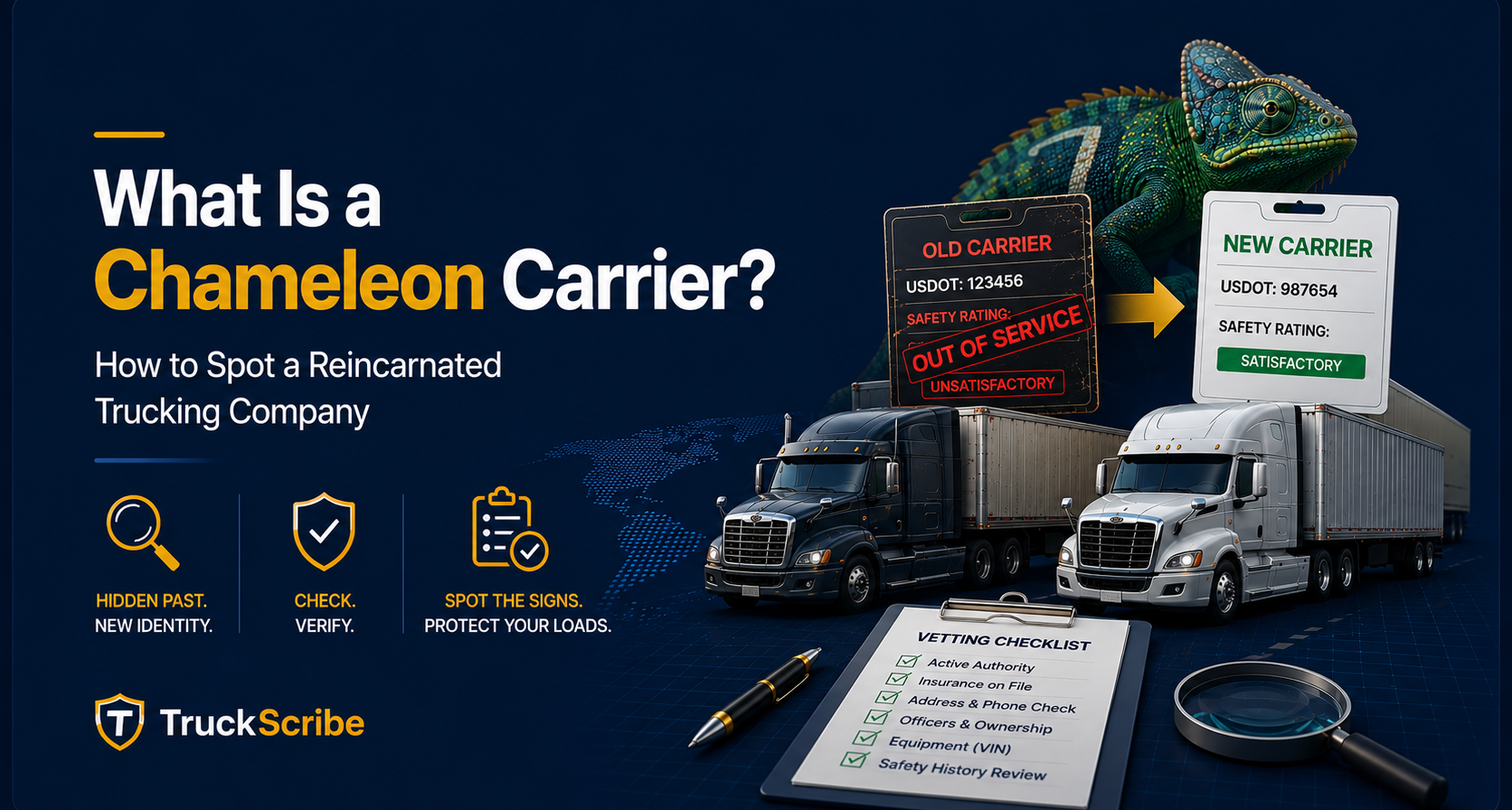
A chameleon carrier, also called a reincarnated carrier, is a trucking company that shuts down and reopens under a new identity to escape a bad history. The old company disappears, and a new one takes its place with a fresh USDOT number, a new name, and a clean-looking record.
Almost nothing else changes. The same owner, the same trucks, the same drivers, and often the same address and phone number keep operating exactly as before. Only the paperwork is new.
FMCSA treats this as an enforcement matter, not a casual label. In its rules, a reincarnated carrier is one tied to a previous operation through common ownership, management, control, or family relationships. The term describes deliberate evasion, not an ordinary USDOT number vs MC number business change.
Why Carriers Reincarnate Under a New Name
The motive is almost always erasing consequences. When a carrier racks up serious safety violations, an out-of-service order, or a poor safety rating, that record follows their USDOT number and scares off brokers, shippers, and insurers.
Rather than fix the problems, some operators start over. They wind down the flagged company, register a new one, and return to the road as if the past never happened. Some even do it to dodge the scrutiny of the new entrant safety audit that every legitimate new carrier must pass, which is part of why the tactic draws so much regulatory attention.
Not Every New Carrier Is a Chameleon Carrier
This point matters, because it is easy to get wrong. A brand new trucking company or a simple name change is not automatically one of them. Thousands of honest operators enter the industry every month, and plenty of legitimate businesses rebrand for ordinary reasons.
The difference is intent and continuity. A true reincarnated carrier exists to hide a specific bad history, and you can usually see the old operation living on underneath the new name. A fresh registration is only worth a closer look when it lines up too neatly with a carrier that recently disappeared under a cloud.
How to Spot a Chameleon Carrier
Because the operation stays the same, the clues are in the details that carry over from the old company. A few minutes of checking usually reveals whether a new carrier is hiding an old identity. The list below breaks down the main warning signs and why each one matters.
- Same physical address: A new carrier at the address of one that just went inactive suggests the same operation continuing.
- Same phone number: Shared contact details tie the new company back to the old one.
- Same officers or owner: Common ownership or management is the core of FMCSA's reincarnation definition.
- Same trucks (VINs): Identical equipment under a new USDOT number shows nothing really changed.
- Suspicious timing: A new authority appearing right after a nearby carrier was revoked is a classic pattern.
On its own, each detail can be a coincidence. Several of them together are what point to a reincarnated operation hiding behind fresh paperwork.
Why Chameleon Carriers Are Dangerous for Brokers and Shippers
The risk is not just regulatory, it hits your freight and your bottom line. Reincarnated carriers have historically shown higher crash rates, because the unsafe practices that got the old company flagged never actually changed. The main exposures fall into a few clear categories.
- Safety risk: These carriers carry the same crash and violation history the new name is meant to hide.
- Cargo and liability claims: A load can be damaged, lost, or stolen while in the hands of a known bad actor you failed to catch.
- Fraud exposure: These operators are a common thread in double brokering and cargo theft schemes that target freight brokers and factoring companies.
- Higher risk in tight markets: Scarce capacity pushes more of these operators back into the freight pool.
What a Reincarnation Pattern Looks Like in Practice
The clearest way to understand the tactic is to picture how it plays out. A carrier with a string of violations gets placed out of service, so its authority is no longer usable and brokers stop tendering it freight.
Weeks later, a new company appears at the same address, run by the same owner, using the same trucks. It has a fresh USDOT number and a spotless record, and to a broker in a hurry it looks like any other new entrant ready for loads.
Nothing about the operation improved. The only thing that changed is the name on the paperwork, which is exactly what makes the pattern so effective and so risky to miss.
How FMCSA Is Cracking Down in 2026
Regulators are paying closer attention than they have in years. FMCSA has announced a renewed push against these operators, leaning on existing rules that let it suspend or revoke registration when a carrier reincarnates to avoid compliance.
A big part of the effort is the MOTUS platform, part of FMCSA's broader Unified Registration System overhaul rolling out through 2026. It adds identity verification and business validation to registration, meant to catch reincarnation patterns before a new authority is ever granted, working alongside checks like the DOT number lookup process brokers already run today.
Enforcement of the Principal Place of Business rule is tightening too. Carriers now need a real physical address rather than a P.O. box, since fake and shared addresses have long been a giveaway of chameleon activity.
How to Protect Yourself Before Booking a Load
You do not have to wait for FMCSA to catch a bad actor. A short vetting routine before you tender a load will catch most reincarnated carriers on your own. Run through these checks before you commit.
- Confirm the carrier holds active operating authority and has insurance on file
- Note how new the registration is, since a very recent authority deserves an extra look
- Compare the address, phone number, and listed officers against any carrier that recently went inactive
- Review the safety history tied to the USDOT number for patterns that do not match a truly new company
A suspiciously clean record on a company whose people and equipment have clearly been around for years is your cue to dig deeper before committing.
Catching Reincarnated Carriers With a Trust Score
Spotting one of these carriers by hand is really just one part of a wider carrier vetting process, cross-checking addresses, phone numbers, officers, and equipment across fragmented federal databases. It works, but it is slow, and busy brokers rarely have time to do it on every load.
This is where a trust score helps. A carrier rating like TruScore includes a chameleon risk check that automatically looks for shared addresses, shared phones, and other carrier files tied to the same operation, then flags the ones worth a second look.
It does not replace your judgment, and it is not an official FMCSA determination. What TruckScribe does is surface the warning signs in seconds, so a reincarnated carrier is far less likely to slip past you before you tender a load. This same signal matters most to freight brokers and factoring companies who tender loads and advance cash before a carrier's true history has a chance to catch up with them.
Frequently Asked Questions
Is changing a trucking company's name illegal?
No. Changing a company name or starting a new business is perfectly legal on its own. It only becomes a problem when a carrier reincarnates specifically to escape a bad safety record, an out-of-service order, or unpaid liabilities.
What is a reincarnated carrier?
Reincarnated carrier is the formal term FMCSA uses for this kind of operator. It refers to a new operation tied to a previous one through common ownership, management, control, or family relationships, created to shed a poor history.
How does FMCSA identify these carriers?
FMCSA screens new applicants for links to previous carriers, looking at shared addresses, officers, and equipment. Its newer MOTUS registration system adds identity verification and business validation to flag reincarnation patterns earlier.
Are reincarnated carriers common?
They are a persistent problem rather than a rare one, and they tend to reappear more often in tight freight markets. Most new carriers are legitimate, but the risk is real enough that vetting is always worth the few minutes it takes.
How do I check if a carrier is reincarnated?
Compare a new carrier's address, phone, and officers against any carrier that recently went inactive, confirm active authority and insurance, and review the safety history on the USDOT number. Matches with a recently closed operation are the clearest sign.
Do chameleon carriers have higher crash rates?
Research has consistently found that reincarnated carriers crash more often than legitimate new entrants. The unsafe habits that flagged the original company usually continue under the new name, which is a large part of why regulators treat the tactic so seriously