Freight fraud is any deceptive practice used to steal cargo, divert payment, or manipulate freight movement through the trucking and logistics system. It targets brokers, carriers, shippers, and factoring companies at nearly every stage of moving a load, from the initial booking to final delivery.
Unlike a single crime with one method, freight fraud covers a range of schemes. Some involve stealing a physical truckload. Others involve impersonating a legitimate business or manipulating paperwork to redirect money. What ties them together is the same vulnerability: freight moves fast, across state lines, often between parties who have never met in person.
Why Freight Fraud Has Become More Common
The freight industry runs largely on trust and speed. A broker posts a load, a carrier accepts it, and the truck moves within hours. That speed is efficient, but it also gives bad actors very little friction to work with.
Digital Load Boards and Remote Booking
Most freight is booked through online load boards and phone calls, without any in-person verification. A fraudster only needs a stolen or fabricated MC number and a convincing story to get a broker to hand over a load.
The Scale of the Problem
According to the Transportation Intermediaries Association's 2025 Fraud Report, unlawful brokerage scams, where criminals pose as legitimate brokers or carriers to hijack loads or payments, were the most frequently reported fraud type, with 402 incidents logged in just six months of tracked data. Cargo theft remains the most financially damaging category, with losses estimated at up to $35 billion a year, according to National Insurance Crime Bureau figures cited in the same report.
The trend is not slowing down. During a February 2026 Senate subcommittee hearing, industry leaders from BNSF, the Owner-Operator Independent Drivers Association, and Academy Sports and Outdoors testified that freight fraud has become common enough that a small trucking business is likely victimized while a single hearing is still in session.
Common Types of Freight Fraud
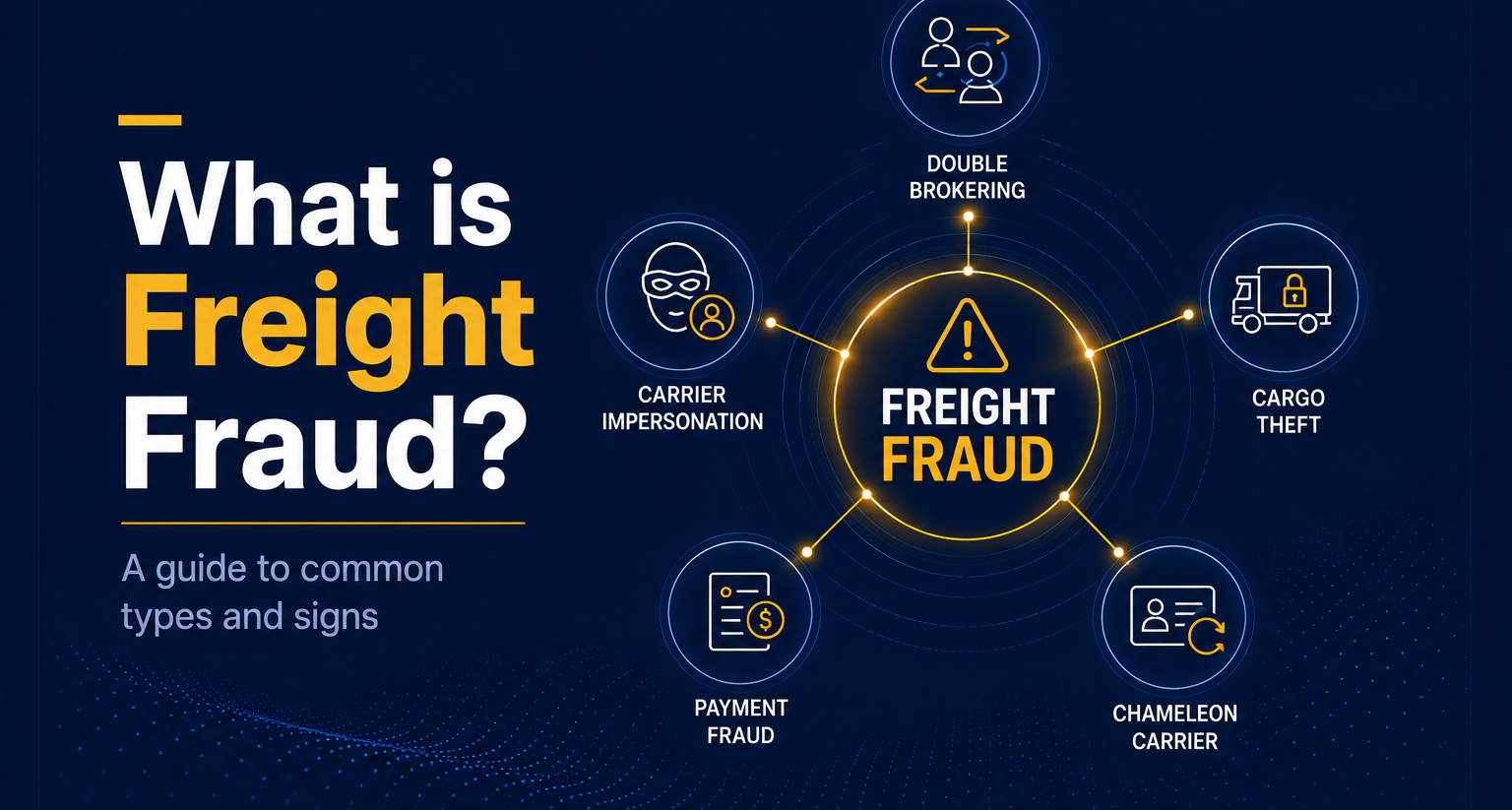
Freight fraud takes several recurring forms. Most schemes fall into one of the categories below, though a single fraud ring often combines more than one.
Double Brokering
A carrier or broker accepts a load, then secretly reassigns it to a different carrier without telling the original broker or shipper. The party in the middle collects a margin while accountability for the actual truck and driver disappears. Double brokering is one of the most common fraud types in the industry and is covered in full detail in a separate guide on what double brokering is and why it happens.
Chameleon Carriers
A carrier with a poor safety record or a revoked authority shuts down and reopens under a new business name, new USDOT number, and often a slightly altered version of the same officer names or addresses. This lets a carrier with a history of violations, crashes, or fraud appear brand new to anyone checking its record. A full breakdown of how this works and how to catch it is available in a dedicated guide on chameleon carriers.
Cargo Theft and Fictitious Pickups
In a fictitious pickup, a fraudster poses as a legitimate carrier, shows up at a shipper's dock with forged paperwork, and drives away with the freight. The load is never delivered, and by the time anyone notices, the truck and cargo are gone. This is sometimes called strategic theft, since it relies on deception rather than a physical break-in.
Identity Theft and Carrier Impersonation
A fraudster steals or copies the USDOT number, MC number, and insurance details of a real, reputable carrier, then uses that identity to book loads under someone else's good reputation. The legitimate carrier often has no idea their information was used until a shipper or broker comes looking for a truck that never arrived.
Payment Fraud and Non-Payment
A broker or intermediary accepts a load, has it delivered, and then never pays the carrier who hauled it. In other cases, a fraudulent party submits duplicate or inflated invoices to collect payment twice for the same shipment.
Factoring and Invoice Fraud
Since many carriers sell their invoices to a factoring company for faster cash, this creates a separate fraud surface. A dishonest carrier might factor the same invoice with two different factoring companies or submit a fabricated invoice for a load that was never actually hauled.
Who Freight Fraud Affects Most
Freight fraud rarely stays contained to one party. A double-brokered load can leave a shipper without their goods, a legitimate carrier without payment, and a broker facing liability for freight they never actually controlled.
Brokers carry a particular exposure, since they are often expected to have vetted the carrier they booked. Factoring companies face direct financial loss when they advance funds against a fraudulent or duplicated invoice. Insurance agencies encounter it indirectly, since a carrier with a fraud history or chameleon pattern is a different underwriting risk than one with a clean, continuous record.
How Freight Fraud Is Typically Detected
Freight fraud usually leaves a pattern, even when the paperwork looks clean. A carrier that registered days ago but claims a decade of experience is worth a second look. So is a new MC number tied to an address, phone number, or officer name that already appears on a different, previously flagged carrier record.
This is part of why a full carrier vetting process matters before a load ever moves. TruckScribe's approach, and specifically a risk-scoring layer like TruScore, looks at chameleon risk and authority track record as separate factors, rather than treating a carrier's paperwork at face value.
How to Protect Your Business From Freight Fraud
No single check eliminates freight fraud entirely, but a few consistent habits reduce exposure significantly.
- Verify a carrier's USDOT and MC number directly against FMCSA records before tendering a load, not just against documents the carrier provided.
- Confirm insurance is active and matches the carrier on file, not a similarly named entity.
- Watch for carriers with very recent registration dates combined with claims of long operating history.
- Call the carrier back at a number pulled independently from FMCSA records, not the number listed on a bid or emailed carrier packet.
- Track authority and insurance status on an ongoing basis after a carrier is approved, since fraud risk can change after the first vetting check.
Frequently Asked Questions
How much does freight fraud cost the industry each year?
Cargo theft alone is estimated to cost the freight industry up to $35 billion annually, according to National Insurance Crime Bureau data cited in TIA's 2025 Fraud Report. That figure does not include payment fraud, invoice fraud, or the operational cost of fraud investigations.
Is freight fraud increasing?
Yes. TIA's Watchdog platform data and member surveys show both the volume and complexity of freight fraud rising year over year, with unlawful brokerage schemes emerging as the most frequently reported fraud type in the most recent reporting period.
Who is liable when freight fraud happens on a booked load?
Liability depends on the specifics of the fraud and the contracts involved, but brokers can face liability if they failed to adequately vet a carrier before tendering a load. This is one reason a documented vetting process matters, beyond simply avoiding fraud itself.
Can freight fraud be reported to the FMCSA?
Yes. Fraudulent carrier or broker activity can be reported to the FMCSA, and cargo theft can also be reported to law enforcement and organizations that track theft patterns across the industry.
What's the difference between freight fraud and cargo theft?
Cargo theft is one type of freight fraud, specifically the physical loss of goods through deception or theft. Freight fraud is the broader category that also includes payment fraud, identity theft, double brokering, and other schemes that do not necessarily involve stolen cargo.