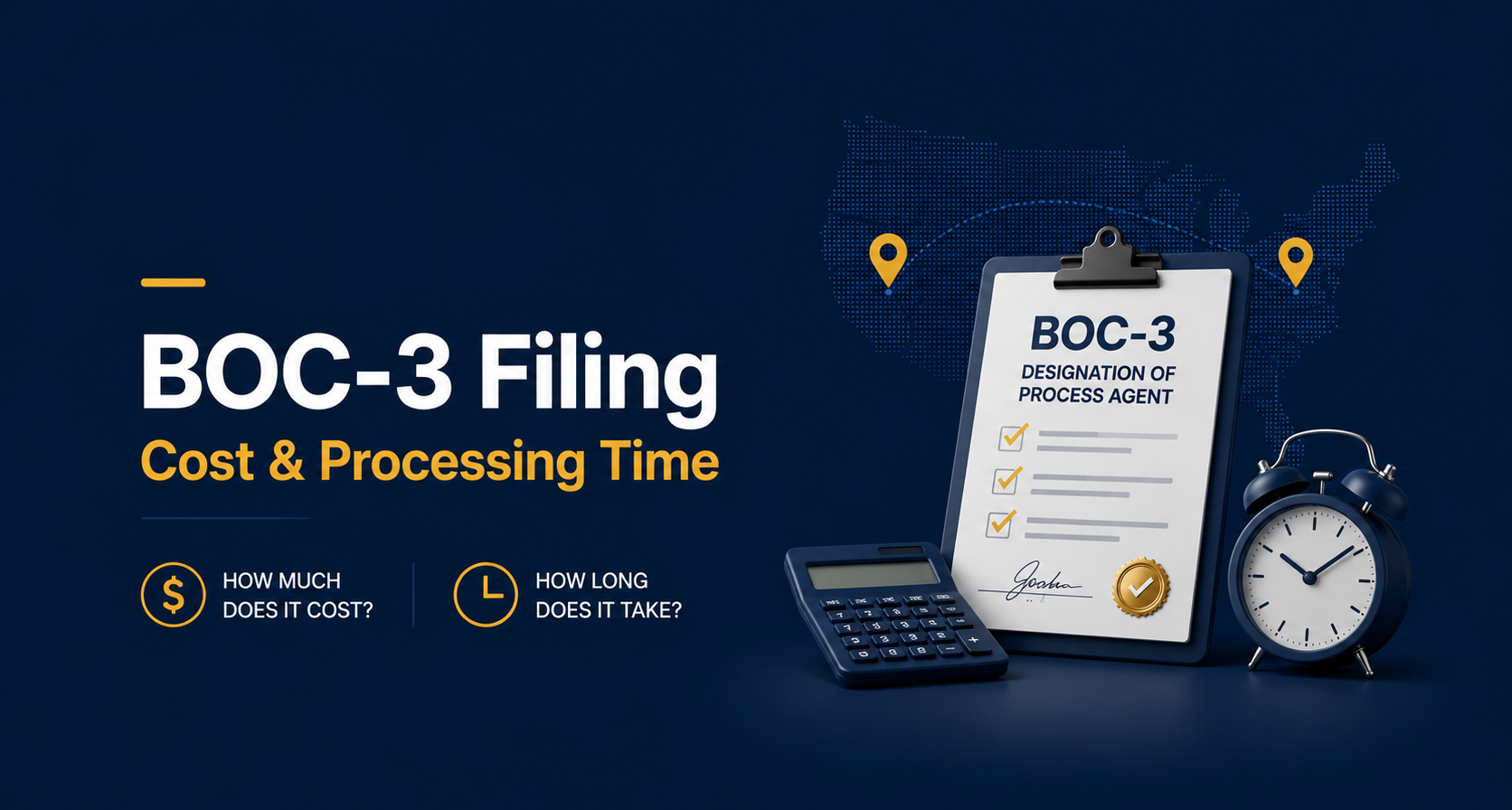
A BOC-3 filing typically costs between $25 and $125 as a one-time fee, paid to the process agent who files it on a carrier's behalf. There is no official FMCSA fee for the filing itself, so every dollar a carrier pays goes directly to the process agent service handling the paperwork.
Most carriers land somewhere in the $50 to $99 range for a reputable blanket filing that covers every state without any recurring cost. Electronic filings typically process in one to three days, sometimes the same day, while paper filings can take weeks.
How Much Does a BOC-3 Filing Cost?
Pricing across the industry spans roughly $20 at the low end to $125 at the high end, depending on the provider and the service level chosen. A basic blanket filing from a straightforward process agent service tends to fall in the $25 to $50 range, while providers bundling additional compliance features or faster guaranteed turnaround charge closer to $75 to $125.
For most new carriers, the cheapest option that still comes from a reputable, electronically filing process agent does exactly the same job as a more expensive one. The core service, designating a process agent in every state a carrier operates, does not change based on price.
It helps to think of the BOC-3 market in three rough tiers. Budget providers around $20 to $40 typically offer nothing beyond the bare filing itself. Mid-range providers around $50 to $75 usually add faster confirmation, customer support, and a clearer paper trail. Premium providers above $75 often bundle in extras like UCR registration or ongoing compliance reminders, which may or may not be worth paying for depending on what a carrier already has in place.
What Determines the Price
A handful of factors separate a $25 filing from one that costs several times as much.
Blanket Coverage vs Per-State Filing
A blanket BOC-3 covers every state in a provider's network under one flat fee, which is how nearly every reputable service prices its filing today. Per-state pricing is rare in practice, but a provider charging separately for individual states will end up costing significantly more than a blanket option.
Bundled Services vs Basic Filing
Some providers roll the BOC-3 into a larger package that includes UCR registration, compliance monitoring, or other filings a new carrier needs anyway. These bundles cost more upfront but can simplify onboarding for a carrier juggling several requirements at once.
One-Time Fee vs Annual Renewal
A properly filed BOC-3 does not expire and does not require an annual renewal at the regulatory level. Any provider charging a recurring yearly fee just to keep the same designation active is charging for something the FMCSA does not actually require.
This is one of the more common ways carriers overpay. A process agent service can legitimately charge more for faster processing or bundled features, but a recurring fee tied to the filing itself, with no underlying change to the designation, is worth questioning before signing up.
The confusion often comes from the fact that a new BOC-3 filing does become necessary if a carrier's information changes, such as a legal name change, a transfer of authority, or a switch to a different process agent. None of these triggers happen automatically or on a yearly schedule, which is exactly why a blanket annual fee rarely reflects any real, recurring work on the provider's part.
How Long Does a BOC-3 Filing Take?
Electronic filing is the standard today, and most reputable process agents submit a BOC-3 within one to three business days of receiving a carrier's information. Some providers process filings within minutes during normal business hours once payment and details are submitted.
Paper filings still exist but move far slower, often taking weeks to process through the FMCSA system. Since a BOC-3 is one of the final steps before operating authority activates, a slow filing method can delay a carrier's ability to legally start hauling freight.
Timing also depends on how quickly a carrier provides the required information. Delays on the carrier's side, such as an incomplete company name or a missing MC number, are just as likely to slow things down as the process agent's own processing speed. Having accurate registration details ready before starting the filing tends to matter more than the specific provider chosen.
How BOC-3 Cost Compares to Other Startup Costs
A BOC-3 filing represents roughly 0.1 to 0.4 percent of a new carrier's total first-year startup costs. Compared to insurance premiums, equipment, and the USDOT and MC registration process itself, the BOC-3 is one of the smallest individual line items a new authority pays for, even though skipping it holds up everything else.
This context matters when comparing providers. The dollar difference between a $25 filing and a $75 filing is small relative to a carrier's overall startup budget, which is why reliability and processing speed are usually worth more than chasing the absolute lowest price.
Put another way, a new authority spending several thousand dollars on insurance and equipment in the same month has little to gain from saving $30 on a BOC-3 filing if that decision means a slower, less reliable provider. The math simply does not favor cutting corners on one of the cheapest required filings in the entire startup process.
What to Look for in a Process Agent Beyond Price
Price alone does not tell the whole story about whether a process agent service is worth using.
- Electronic filing, since paper submissions take weeks longer to process
- No recurring annual fees for a filing that does not require renewal
- A track record of several years in business, which signals stability
- Confirmation the filing appears in the FMCSA system, not just a receipt from the provider
Choosing the wrong provider carries more risk than most new carriers expect. Reviewing patterns behind freight fraud is a useful exercise here too, since some low-quality process agent operations mirror the same red flags seen in other trucking-adjacent scams, taking payment without ever completing a legitimate filing.
A quick way to check a provider's legitimacy before paying is searching for independent reviews on trucking forums rather than relying solely on the testimonials shown on the provider's own website. A company with years of consistent, verifiable filings behind it is a far safer bet than one with a slick website and no outside track record to confirm the claims.
When to File a BOC-3 in the Registration Process
A BOC-3 is one of the last pieces of a broader registration sequence, and new carriers sometimes file it before fully deciding how they will actually operate. Understanding the difference between working with a broker and a dispatcher earlier in that process can shape decisions made around the same time as the BOC-3 filing, even though the two are unrelated requirements.
For carriers weighing whether to handle dispatch themselves or bring on outside help, this is often the same window where a freight dispatcher relationship gets established, right alongside naming a BOC-3 process agent.
Frequently Asked Questions
Is there an official FMCSA fee for a BOC-3?
No. According to the Federal Motor Carrier Safety Administration, the BOC-3 form itself carries no government filing fee. Everything a carrier pays goes to the process agent service handling the submission.
Can a cheap BOC-3 filing cause problems later?
A low price by itself is not a problem. The issue arises when a low-cost provider fails to file electronically, lacks a real network of state-level agents, or disappears after taking payment. Checking reviews and confirming electronic filing matters more than the price tag.
Do I need to refile if I switch process agents?
Yes. Switching process agents requires a new BOC-3 filing naming the new agent, since the designation is specific to whichever provider is currently listed on file with the FMCSA.
Does filing cost vary by how many states I operate in?
Generally no, as long as the provider offers blanket coverage. A blanket BOC-3 covers every state in that provider's network under one flat fee, rather than charging per state.
What happens if my BOC-3 filing is delayed?
Since the BOC-3 is required before operating authority activates, a delayed filing directly delays a carrier's ability to legally begin hauling freight. This is part of why choosing a BOC-3 agent with fast, electronic processing matters more than shaving a few dollars off the price.
A carrier facing a delay should confirm directly with their process agent whether the holdup is on the provider's end or waiting on additional information from the FMCSA itself, since the two situations call for different next steps.
For carriers managing multiple pieces of the registration process at once, keeping everything organized in a TruCRM style pipeline can help track which filings are complete and which are still pending, rather than losing track of a BOC-3 among all the other startup paperwork.