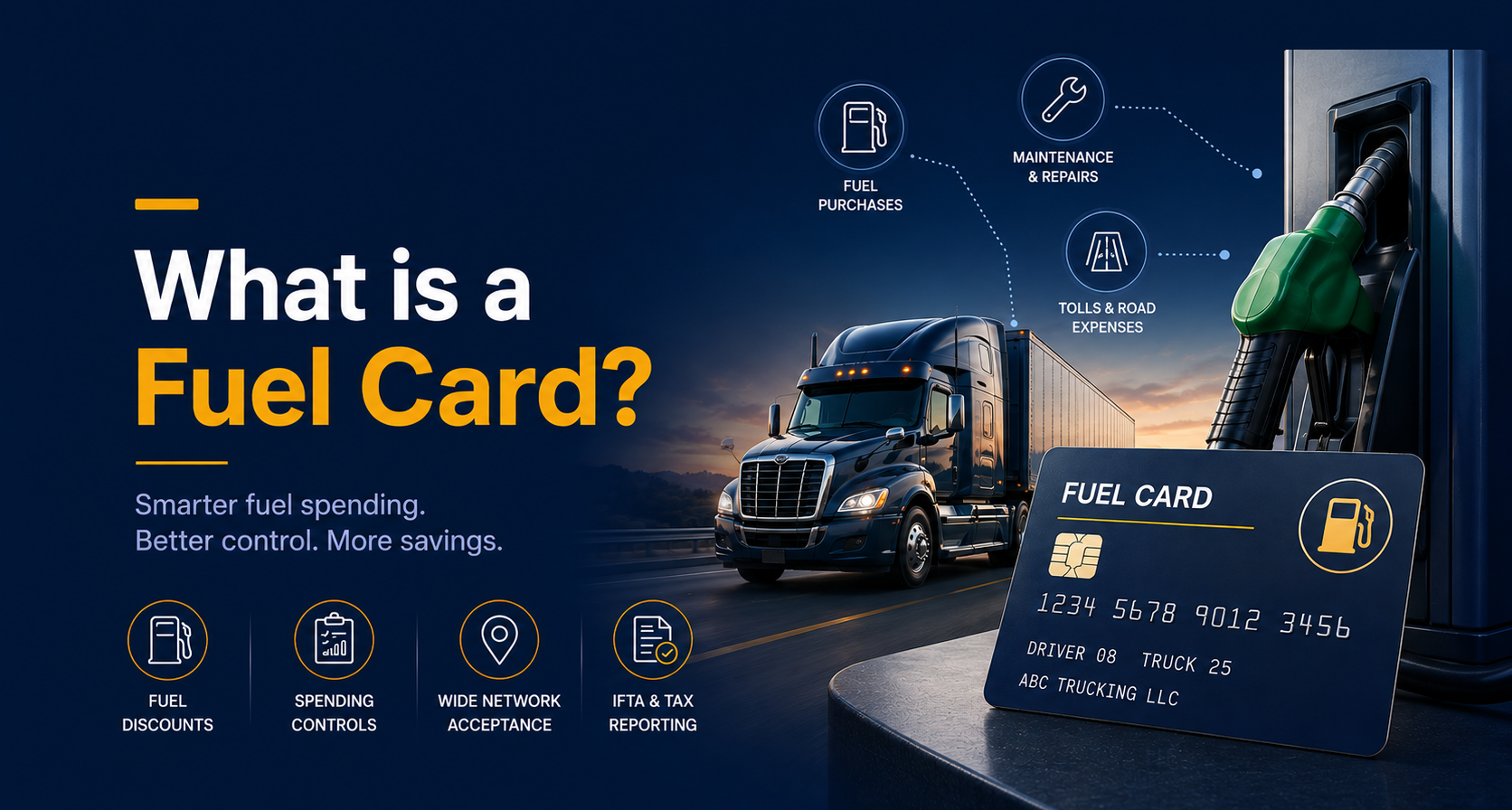
A fuel card is a payment card built specifically for buying fuel and related expenses at the pump, with spending controls and reporting built in that a regular credit card does not offer. For a trucking company, it replaces handing a driver cash or a personal card and hoping the receipts come back intact.
Fuel cards are sometimes called fleet cards, since most cover more than fuel alone. For a business running even a handful of trucks, a fuel card is usually one of the first tools adopted, right alongside dispatching and basic bookkeeping.
What Is a Fuel Card?
A fuel card is a business payment card issued to a trucking company or fleet, then distributed to drivers to pay for fuel and other approved expenses on the road. Unlike a personal card, every transaction is tied back to the company account, the specific driver, and often the specific truck.
The company that issues the card, not the driver, sets the rules. A fleet manager can restrict a card to fuel purchases only, cap daily spending, or block certain merchant categories entirely, which is not something a standard credit card allows.
How a Fuel Card Actually Works
At the pump, a driver inserts or swipes the card, then usually enters a driver ID or PIN along with the truck's odometer reading. That extra step is what separates a fuel card from a regular card, since it ties the purchase to a specific driver and vehicle instead of just a company name.
The transaction data flows into the fleet's account in something close to real time, showing location, gallons purchased, price per gallon, and the vehicle involved. At the end of a billing cycle, the company pays the balance, similar to a TruCRM pipeline consolidating scattered activity into one place, except here it is fuel spend instead of sales activity.
Some fuel card programs operate on a charge card model, where the balance must be paid in full each cycle, while others function closer to a revolving credit line. The right structure depends on how a fleet manages cash flow, and newer carriers in particular tend to favor the predictability of a charge model over carrying a balance.
What a Fuel Card Typically Covers
Most fuel cards extend well beyond diesel at the pump, and the exact coverage depends on the card program a company chooses.
Fuel Purchases
This is the core function. Diesel, DEF, and sometimes gasoline for support vehicles are the primary purchases a fuel card is built around, often with per-gallon discounts at network locations.
Maintenance and Roadside Services
Many fuel cards also cover tire repairs, oil changes, and roadside assistance at participating truck stops, so a driver is not paying out of pocket for a breakdown two states from home.
Tolls and Related Expenses
Some cards extend to toll payments along a driver's route, consolidating what would otherwise be scattered charges into a single, trackable business expense.
Fuel Card vs a Regular Credit Card
A regular business credit card technically works at a fuel pump, but it offers almost no control once it is in a driver's hands. There is no way to restrict purchases to fuel only, no per-transaction driver ID, and no built-in reporting broken down by vehicle.
A fuel card closes that gap. Spending limits, merchant restrictions, and driver-level tracking are standard features, not add-ons, which is why most fleets move to a dedicated fuel card the moment they have more than one or two trucks to manage.
Who Provides Fuel Cards for Trucking
The fuel card market has consolidated heavily over the years, and two companies now dominate most of the space: Fleetcor, which operates the Comdata and Fuelman brands, and Wex, which operates EFS, T-Chek, TCH, and FleetOne.
Nearly every fuel card a trucking company encounters traces back to one of these two networks, even when the card carries a different name on the front. Understanding this helps explain why network acceptance tends to look similar across seemingly different card brands.
A handful of independent and truck-stop-affiliated programs exist outside these two networks as well, often built around a specific chain's own locations. These can offer stronger discounts within their own network but weaker coverage outside it, which is why route planning matters as much as brand reputation when picking a card.
How Fuel Cards Help With IFTA Reporting
The International Fuel Tax Agreement, or IFTA, requires carriers operating across state lines to report fuel purchased and miles driven in each jurisdiction every quarter. According to the Federal Highway Administration, accurate fuel and mileage recordkeeping is central to compliant interstate operation, and a fuel card automates most of that recordkeeping by default.
Every transaction already captures the state, gallons, and date, which means the raw data for a quarterly IFTA filing exists automatically instead of being reconstructed from paper receipts after the fact.
What to Look for in a Fuel Card
Not every fuel card fits every fleet, and a few factors separate a good fit from a frustrating one.
Network Acceptance
A card is only useful where a driver can actually use it. Checking coverage along a fleet's typical routes matters more than a card's advertised discount rate.
Discount Structure
Some cards offer flat discounts per gallon, others use a cost-plus model tied to wholesale fuel prices. The better option depends on fuel volume and how predictable a fleet's routes are.
Spending Controls and Reporting
The ability to set per-driver limits, restrict purchase categories, and pull reports by vehicle or driver is often the real value of a fuel card, more than the discount itself.
Do New Carriers Need a Fuel Card on Day One?
A brand new authority does not strictly need a fuel card to legally operate, unlike insurance or a USDOT and MC number, but most new carriers adopt one quickly once real fuel spend starts adding up. Without one, a new owner-operator is either paying cash or putting fuel on a personal card and trying to separate business expenses after the fact.
Fuel spend is also one of the operational costs that shows up alongside other early decisions a new carrier makes, similar to picking an ELD provider or evaluating telematics for the fleet. None of these are legally required on day one, but all three tend to get adopted in the same early window as a carrier moves from paper processes to something more structured.
Frequently Asked Questions
What's the difference between a fuel card and a fleet card?
In practice, the terms are used interchangeably. A fleet card technically implies broader coverage beyond fuel, such as maintenance and tolls, but most fuel cards marketed to trucking companies already include those features.
Can an owner-operator get a fuel card with no credit history?
Some fuel card providers offer prepaid or secured options specifically for new authorities without an established credit history, though terms and discount levels are typically less favorable than a standard credit-based account.
Do fuel cards offer real discounts, or just convenience?
Both. Network discounts at partner truck stops are real and can meaningfully reduce fuel costs at volume, but the spending control and reporting features often deliver more value than the discount alone for a growing fleet.
Can a fuel card be used for non-fuel purchases?
It depends on how the fleet manager configures the card. Many programs allow maintenance, tolls, and truck stop amenities by default, but a company can restrict a card to fuel-only purchases if that fits their policy better. This is the kind of expense-category control that pairs naturally with an ELD tracking a driver's hours on the same trip.
How do fuel cards affect fleet fuel tax reporting?
Fuel cards automatically capture the state, date, and gallons for every purchase, which is the exact data needed for quarterly IFTA filings. This removes most of the manual work of reconstructing fuel records by hand each quarter, similar to how commercial trucking insurance filings and a transportation management system both reduce manual recordkeeping elsewhere in a carrier's operation.
For carriers managing all of these moving pieces at once, from insurance to ELD compliance to day-to-day dispatch, TruckScribe keeps the underlying FMCSA and authority data current, so the operational side of the business is not the only part staying organized.