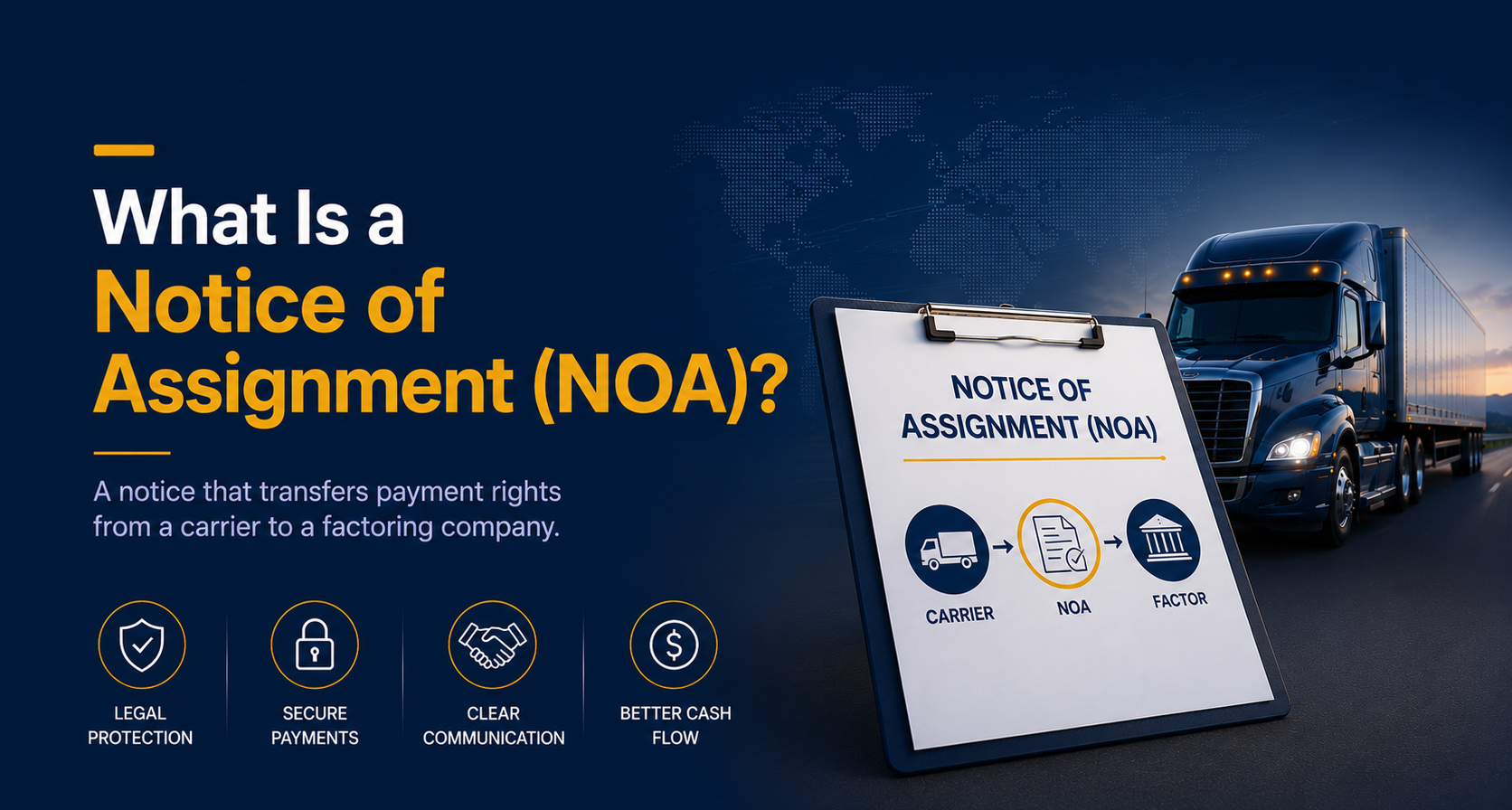
A notice of assignment is a legal document a factoring company sends to a broker or shipper, informing them that a carrier's invoice has been sold to the factor and that payment must now go to the factoring company instead of the carrier. It exists because once a carrier factors an invoice, the factoring company legally owns the right to collect on it.
Without a notice of assignment, a broker has no way of knowing an invoice changed hands, which creates a real risk of paying the wrong party or paying twice for the same load.
What Is a Notice of Assignment?
A notice of assignment, often shortened to NOA, formally transfers the right to collect payment on a specific invoice from the carrier to the factoring company. Once issued, the broker or shipper named on the notice is legally obligated to send payment to the factor, not the carrier who hauled the load.
This document is standard practice anywhere invoice factoring happens, but it shows up constantly in trucking specifically, since freight factoring is one of the most common financing tools carriers use to manage cash flow between loads.
How a Notice of Assignment Works
The process starts with a completed load. A carrier delivers freight and submits the invoice to its factoring company instead of waiting on the broker or shipper to pay directly.
The factoring company reviews the invoice and advances most of its value to the carrier, typically 70 to 95 percent, within a day or two. At that point the factoring company sends the notice of assignment to the broker or shipper, notifying them that future payment on that invoice, and often all future invoices from that carrier, must go to the factor.
When the broker's payment terms come due, they pay the factoring company directly. The factor then releases whatever remaining balance is owed to the carrier, minus its fee, closing out that invoice.
This entire cycle typically repeats without much friction once a broker relationship is established and the first NOA has been sent and confirmed. New loads from the same carrier to the same broker generally do not require a fresh notice each time, since the original assignment already covers the ongoing relationship.
What Information a Notice of Assignment Includes
A notice of assignment is a short document, but it needs to contain enough detail to leave no ambiguity about where payment should go.
- The carrier's business name and contact information
- The broker or shipper's name, as the party being notified
- The invoice number and load details tied to the assignment
- A clear statement that the factoring company now owns the right to collect payment
- Instructions for where and how to send payment going forward
Why a Notice of Assignment Matters
The document protects three different parties at once, each for a slightly different reason.
Protecting the Factoring Company
The factor has already advanced cash against the invoice, so it has a direct financial stake in making sure payment comes to it rather than the carrier. The NOA is what gives that claim legal standing with the broker.
Protecting the Broker or Shipper
A broker who receives a clear notice knows exactly where to send payment, which removes any ambiguity if a dispute comes up later about who was supposed to be paid.
Protecting the Carrier
Somewhat counterintuitively, the NOA also protects the carrier. It formalizes the factoring relationship on record, which matters if a payment dispute ever affects the carrier's standing with a broker or shows up as a factor in how a freight brokers team evaluates the carrier going forward.
An NOA also gives a carrier a documented paper trail if a broker relationship ever turns into a payment dispute. Rather than relying on informal agreements or verbal payment terms, the notice creates a clear, dated record showing exactly when the factoring arrangement began. That record can matter later, whether a carrier is resolving a disagreement with a broker or simply keeping accurate books for its own accounting purposes.
What Happens If a Broker Ignores the NOA
A broker who pays the carrier directly after receiving a valid notice of assignment does not automatically get to walk away clean. In most cases, the broker remains legally responsible for paying the factoring company as well, since the NOA created a binding obligation the moment it was received and acknowledged.
This is how double payment situations happen. A broker pays the carrier out of habit or oversight, then still owes the factoring company the same amount, effectively paying for the same load twice. It is a costly mistake, and it is exactly why factoring companies take NOA delivery and confirmation seriously rather than treating it as a formality.
Larger brokerages typically build a process specifically to prevent this, flagging any carrier with an active NOA on file so accounts payable staff never accidentally issue payment to the wrong party. Smaller brokerages without that kind of system in place are the ones most likely to run into a double payment situation, simply because the notice gets buried in an inbox instead of tied to the carrier's record.
Who Sends the Notice of Assignment
The factoring company almost always sends the NOA, not the carrier. Since the factor is the party collecting payment and has the legal and financial interest in the broker's compliance, it makes sense that they handle the notice directly rather than leaving it to the carrier to manage. Many factoring companies track this process inside their own version of a TruCRM style pipeline, logging exactly when a notice was sent and confirmed for each broker relationship.
Some factoring agreements do involve the carrier in the process, particularly for smaller or newer factoring relationships where the carrier introduces the factor to a broker they already work with. But the actual notice itself is drafted and issued by the factor in nearly all cases.
Notice of Assignment vs Assignment of Claims
These terms get used interchangeably, and in most freight factoring contexts they refer to the same underlying concept. Assignment of claims is the broader legal term for transferring the right to collect a debt or receivable, while notice of assignment specifically refers to the document that communicates that transfer to the party who owes the money.
In practice, when someone in trucking says notice of assignment, they mean the letter a factoring company sends a broker. When the same concept appears in general commercial or government contracting law, it is more often referred to as an assignment of claims, following the federal Assignment of Claims Act framework that governs how receivables can be legally transferred.
For most carriers and brokers working within standard freight factoring relationships, this distinction rarely matters in day to day practice. The two terms describe the same mechanism from slightly different angles, and either one is generally understood correctly within the industry.
Frequently Asked Questions
What happens if a broker pays the carrier by mistake after an NOA is sent?
The carrier should not deposit that payment and should notify the factoring company immediately. The factor typically follows up with the broker to redirect the funds correctly, and a second notice may be sent to reinforce the original instructions.
Does every factored invoice need its own NOA?
Not necessarily. Many factoring relationships send one notice of assignment covering all future invoices from a carrier to a specific broker, rather than issuing a new notice for every single load.
Can a carrier cancel a notice of assignment?
Generally, only the factoring company can formally cancel or revise an NOA, since they are the party who issued it and holds the legal interest it protects. A carrier ending its factoring relationship would need the factor to send a release or cancellation notice to the broker.
Is a notice of assignment the same as a factoring agreement?
No. The factoring agreement is the contract between the carrier and the factoring company that sets the terms of the relationship. The notice of assignment is a separate document sent to a third party, the broker, informing them of the payment change. This distinction matters the same way understanding commercial trucking insurance coverage types matters, since two related documents can serve very different legal purposes within the same business relationship.
How long does a notice of assignment stay in effect?
It typically remains in effect for as long as the factoring relationship between the carrier and factor continues, or until the factor issues a formal release. Brokers working with a factoring companies desk on a regular basis often keep an NOA on file indefinitely once a carrier relationship is established, updating it only if the carrier switches factors.
Managing these payment relationships is one more piece of the broader carrier verification picture that comes up across new authority operations, similar to how a TMS and a DOT audit both touch different parts of a carrier's compliance record. For teams that need to keep track of authority status and business relationships across a growing carrier network, TruckScribe keeps that underlying FMCSA data current in one place.